Aviator by Spribe: Full Research Guide to the Crash Game, Its Math, Provably Fair Engine, Demo Mode, and Real-Money Play

Last updated: February 2026 · Reviewed by the iGaming analytics desk · 19+ in most Canadian provinces (18+ in AB, MB, QC) · Play responsibly

Aviator is the crash game that turned a single rising number into one of the most-played formats in online gambling. A red plane takes off, a multiplier climbs from 1.00x, and you decide when to press Cash Out. Wait too long and the plane flies away with your stake. Cash out too early and you leave money on the table. Everything else in this guide, the probability formula, the provably fair hash chain, the demo mode, the casino selection criteria, exists to answer two practical questions: what exactly am I betting on, and what does the math actually allow.

Why does this matter to you specifically? Because in Canada the game is the easy part. The harder part is the operator sitting behind it: whether your province allows the site, whether your CAD withdrawal clears through Interac in hours or in a week, and whether Aviator counts toward a welcome bonus at all. That is where money is actually won or quietly lost.

Our editorial team analyses crash-game products, operator terms, and payout mechanics as part of our ongoing iGaming research practice, and this guide reflects that methodology: primary vendor data first, peer-reviewed and regulator evidence second, marketing claims last. Where we could not verify something, we say so.

Aviator by Spribe Full Research Guide

On This Page

  1. Aviator at a glance: key parameters
  2. Conceptualizing Aviator as a Crash Game
  3. Aviator Demo and Free Play
  4. Playing Aviator for Real Money
  5. Choosing an Online Casino for Aviator Play
  6. Aviator Strategy: Probability, Expected Value, and Variance
  7. Fairness, Provably Fair Architecture, and RTP Verification
  8. Alternatives to Aviator: the wider crash-game market
  9. Responsible Gambling, Access Restrictions, and Player Protection
  10. Evidence Map and Methodological Appraisal
  11. FAQ

Aviator at a Glance: Key Parameters

Two sentences before the detail. Aviator is a multiplayer crash game released by Spribe in 2019, running at a fixed theoretical RTP of 97% with a 3% house edge. Rounds last roughly 8 to 30 seconds, the interface supports two simultaneous bets, and every outcome is committed cryptographically before the plane takes off.

ParameterValue
Game typeCrash game (multiplayer, single-decision)
ProviderSpribe
Release date2019
Theoretical RTP97% (house edge 3.00%)
VolatilityHigh (player-selectable variance via cash-out target)
Round length~8 to 30 seconds; betting window ~5 seconds
Simultaneous bets2 independent bet panels per round
Auto featuresAuto Bet (10 to 100 rounds), Auto Cash Out (target capped at x100 on most builds)
Typical bet range~C$0.10 to C$100 at most regulated operators; up to roughly C$7,000 at some high-limit sites
Theoretical max multiplierx1,000,000 per round
Instant crash frequency~3% of rounds crash at exactly 1.00x
Fairness modelProvably fair (SHA-256 commitment, SHA-512 result hash)
PlatformsWindows, macOS, Android, iOS, via browser or web client at operator sites

One practical note for Canadians reading that bet range: the C$0.10 floor is what makes Aviator testable. You can validate the interface, the animation stability, and your own reaction time for the price of a coffee refill.

Conceptualizing Aviator as a Crash Game

This section explains what genre Aviator belongs to and why the format behaves so differently from reel-based slots. The short version: the multiplier is a single continuous random variable, and your only input is the exit timing.

Crash gambling mechanics and Aviator's position in the genre

Crash games are a betting genre in which a multiplier rises from 1.00x until a randomly determined stop, and the player must cash out before the crash to lock in the current value. That single continuous outcome is the structural difference that separates crash games from conventional slots, where each spin is resolved discretely against fixed paylines and symbol combinations.

«Crash games are described as "easy to learn", yet extremely high multipliers are statistically rare and are offset by frequent early crashes that pay nothing.» — Scott, Sher & Daigle, UNLV Gaming Research & Review Journal

The genre took shape in the late 2010s and early 2020s, first on crypto-native platforms and then across mainstream operators. Its rise is tied to three product properties: browser-first delivery, extremely short round cycles, and a social layer (shared rounds, live bet feeds, in-game chat) that reel slots cannot replicate. Aviator became the most recognisable implementation of the format, to the point that "aviator game" now functions as a genre label in several markets, in the same way "Book of" became shorthand for a certain slot family.

The visual metaphor matters more than it first appears. Aviator centres the interface on a plane ascending against a plain sky, so the multiplier reads as altitude rather than as an abstract counter. The plane is the countdown cue for exit timing: players report making decisions against the visual arc of the climb, not against the numeric value. That is a design choice with behavioural consequences, and it is one reason crash games feel like skill games even though, as the math section below demonstrates, the exit decision changes variance and nothing else.

Worth saying plainly. Feeling in control and being in control are not the same thing here.

The genre took shape in the

How an Aviator round unfolds: bet placement, flight, multiplier growth, and crash

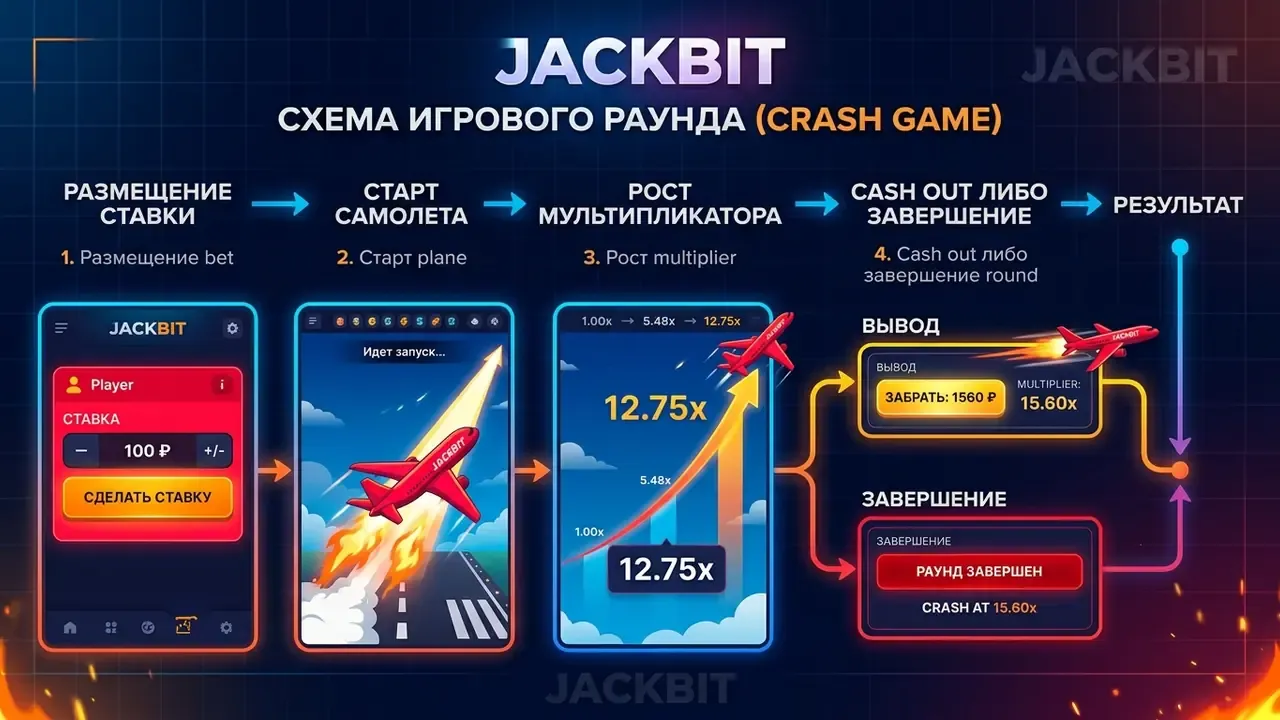
A round proceeds through four discrete states. Understanding them in order removes almost all of the confusion new players have about "why did my bet not register".

  1. Betting or waiting phase. During the pause between rounds, usually about five seconds, you set a stake in one or both bet panels and confirm. The stake is locked for that round only. If the previous round is still in flight when you open the game, you simply wait for the plane to fly away and the next betting window to open.
  2. Takeoff at 1.00x. The round starts, the plane lifts off, and the multiplier begins at exactly 1.00x.
  3. Real-time multiplier growth. The coefficient rises continuously. You may press Cash Out at any moment; the payout equals your stake multiplied by the coefficient displayed at the instant of the click. With two bets active, each is cashed out separately.
  4. Cash Out or Fly Away. If you exit in time, the win is credited. If the plane reaches Fly Away first, the round ends and the stake for any un-cashed bet is lost.

Rounds are short by design, which allows many rounds per session compared with longer slot spins or live table games. Sixty to ninety rounds per hour is a realistic session tempo, and that tempo, not the per-bet edge, is what determines how much money passes through the game in an hour.

How an Aviator round unfolds bet

«The crash-game algorithm iteratively checks the worst possible payout at each multiplier tick and stops the round when continuing would exceed the payout budget.» — ArXiv preprint on crash-game multiplier distributions (2026)

Two structural facts about round outcomes deserve emphasis, because they are the most misunderstood part of the format. First, approximately 3% of rounds are documented to crash at exactly 1.00x, meaning even players who hoped to cash out quickly had no opportunity to do so. Evidence note: this figure is reported consistently across independent crash-game analyses of 97% RTP builds, roughly "1 in every 33 rounds, the plane crashes before anyone can cash out", but no peer-reviewed source with a published sampling methodology has yet validated it for Aviator specifically. Treat 3% as the vendor-consistent design figure and the primary mechanism that enforces the house edge, not as an independently audited measurement. Second, each round is cryptographically independent: a run of ten instant crashes changes nothing about the eleventh.

Bet sizing at scale matters here too. Typical bet ranges at regulated operators span from about C$0.10 to C$100 per round, with a handful of high-limit and crypto-facing platforms extending the ceiling considerably further. Because payouts including fractional amounts are rounded down to two decimal places, very small stakes at very low multipliers can round against you. A C$0.10 stake cashed at 1.03x pays C$0.10, not C$0.103. Small, but it is the kind of detail that tells you how the client actually behaves.

Two structural facts about round outcomes

Round flow, step by step (for reference or diagram use)

Waiting / BettingTakeoff at 1.00xMultiplier grows in real timeCash Out (payout = stake × current multiplier) or Fly Away / Crash (stake lost)Next betting window opens

Glossary of core Aviator terms

Because interface labels vary slightly between operator builds, here are the terms as they appear in the official Spribe client.

TermDefinition
BetThe stake locked into one bet panel for a single round. Two panels can be funded independently.
Cash OutManual exit that settles the bet at the multiplier shown at the moment of the click.
Auto BetAutomated re-staking across a scheduled number of rounds (commonly 10 to 100), with stop conditions.
Auto Cash OutA pre-set multiplier at which the bet is settled automatically, without a manual click.
Multiplier / CoefficientThe rising value starting at 1.00x that determines the payout.
Fly Away / CrashThe round-ending event. Any un-cashed stake is lost.
Round HistoryThe list of previous crash points. Informative only, with no predictive value.
Provably FairThe cryptographic commitment scheme that lets a player verify a round was determined before it began.
All Bets / My Bets / TopSide-panel feeds showing other participants' stakes, your own history, and record multipliers.

Evidence note: no peer-reviewed or regulator source defines these interface terms; the definitions above are reconstructed from the official Spribe client, operator help pages, and hands-on testing by our team.

Aviator Demo and Free Play

Two sentences up front. Demo mode runs the same game logic on a virtual balance, so it is the correct place to learn the controls and the rhythm of the round. It is not a place to "test a strategy", because a demo session cannot reveal an edge that does not exist.

The role of Aviator demo and free play for novice players

Aviator's demo build is typically available without a deposit, and at many operators without registration. It loads with a virtual balance that resets or replenishes, and vendor-facing materials describe the same game logic and RNG in demo and real-money modes, with only the stake and payment layer changing. That makes aviator free play genuinely useful for four things: learning where the Cash Out button is and how fast you can reach it; configuring Auto Bet and Auto Cash Out safely; feeling the actual duration distribution of rounds; and confirming your device and connection can handle live animation without lag.

If you play on mobile data in a basement suite or on transit, that last point is not trivial. A half-second animation stall during a 1.80x climb is a real cost, and the aviator demo is where you find out about it for free.

There is also a documented commercial effect on the operator side, which is worth knowing because it explains why demo access is promoted so aggressively:

The role of Aviator demo and

«Deploying an instant demo with a micro-bonus and low wagering requirements produced a 10 to 25% lift in seven-day player retention.» — Crash gambling retention case study (2025)

The same case study reported that a 60-second onboarding demo paired with a small token and low wagering requirements was associated with that 10 to 25% lift in seven-day retention. Read that as a design incentive, not as a player benefit: a smoother onboarding path increases the probability that a casual visitor becomes a depositing customer.

What demo mode cannot do is equally important. Virtual credits remove financial consequence, which removes the emotional pressure that actually drives poor real-money decisions, the impulse to hold for one more tick, or to double up after an instant crash. A "profitable" demo session is a variance artefact, nothing more. I have watched a demo balance triple in twenty rounds and mean absolutely nothing.

The same case study reported that

Playing Aviator for Real Money

Transitioning from demo to real-money Aviator via online casinos

The mechanical path is short: choose a licensed operator, register an account, complete verification, deposit in CAD, open the crash-games category, and place a stake. Each step, however, carries a specific check worth making before you commit money.

  1. Select the operator. Confirm the licence, the jurisdiction, and that the game is listed with Spribe as provider rather than an unbranded clone. In Ontario, that means an iGaming Ontario registered site under AGCO oversight; elsewhere in Canada, provincial platforms and offshore-licensed operators sit in different legal categories, and it pays to know which one you are on.
  2. Register and verify. This means registering an account and completing any required identity verification under anti-money laundering (AML) and know-your-customer (KYC) rules. Under the FATF risk-based framework, customer due diligence, beneficial-owner identification, enhanced checks for higher-risk cases, and suspicious-transaction reporting are mandatory for licensed operators, so verification requests are a sign of compliance, not obstruction. Choosing a properly licensed online casino at this stage avoids the most common failure point, which is a withdrawal blocked at KYC after the money has already been staked.
  3. Deposit. Check the cashier for the same payment method you intend to withdraw to. Mismatched rails are the second most common cause of payout delays, and in Canada this bites hardest when a player deposits by credit card and then expects an Interac e-Transfer back out.
  4. Find the game. Look for a dedicated "Crash", "Burst", or "Quick Games" category. On several platforms Aviator is pinned to the front page.
  5. Start small. Minimum bets are often as low as C$0.10, which is enough to validate the interface with real stakes before scaling.
  6. Withdraw deliberately. Read the stated processing time, pending period, and minimum and maximum payout limits before your first cash-out request, not after.

Here is what that means for you in practice: the fastest CAD rails are usually Interac e-Transfer and e-wallets, often same-day once verification is cleared, while card refunds and bank transfers can run three to five business days. Test the withdrawal path with a small amount early. It is the single most informative thing you can do at a new site.

The behavioural risk in this transition is well documented. Losing a stake and immediately re-betting larger is a phenomenon known as within-session chasing, which raises the risk of escalating losses.

Transitioning from demo to real-money Aviator

«Players placed larger bets and ran longer sessions after immediate losses, while accumulated losses eventually led to reduced stakes.» — Scientific Reports, behavioural tracking study of PlayNow.com data (2024)

Crash games compress this cycle into seconds. Where a slot player waits for reels and a table player waits for a dealer, an Aviator player can chase a loss within eight seconds of incurring it. That compression is the single strongest argument for setting limits before the first real-money round.

Bet controls in practice: dual panels, Auto Bet, and Auto Cash Out

The interface gives you three mechanical tools, and each one is a variance instrument rather than an edge instrument.

  • Two bet panels. Two independent bets in the same round, each with its own stake and its own cash-out. The common configuration is a low-target bet (say 1.30x) to recover most of the combined stake, plus a high-target bet left to run. This is a hedge that reshapes the payout distribution; it does not change expectation.
  • Auto Bet. Click the Auto tab, select Auto Play, and schedule 10 to 100 rounds. Available stop conditions include: stop if cash decreases by a specified amount; stop if cash increases by a specified amount; stop if a single win exceeds a specified amount. Used properly, these are hard-coded stop-loss and stop-profit limits, arguably the most useful responsible-gambling feature inside the game itself.
  • Auto Cash Out. Toggle it on and set the target multiplier at which the stake is settled automatically. The maximum configurable coefficient is capped at x100 on standard builds. Auto Cash Out removes reaction time from the equation, which eliminates the "froze and lost it" failure mode entirely.

Also in the client: a hamburger menu for animation, sound, and music settings, plus full rules, table limits, betting history, and the Provably Fair verification tool.

Bet controls in practice dual panels

Welcome bonuses and other promotional offers: impact on Aviator play

Promotions are the primary acquisition mechanism in this market, and their reach is measurable.

«Around nine in ten respondents received at least one promotional offer in the previous four weeks; 76% of those who received an offer went on to use it.» — UK Gambling Commission / Yonder, Consumer Journeys Report (2023)

The critical detail for crash-game players is game contribution to wagering requirements. Because Aviator is a crash game, many casinos either exclude it from the welcome bonus or count it at a reduced percentage toward the wagering requirement. Free spins are frequently slot-only. Cashback and dedicated free bets ("70 FB in Aviator", for example) are the offer types most likely to apply directly. Always confirm four things in the terms: the wagering multiple, the qualifying games list, Aviator's contribution percentage, and the maximum bet permitted while a bonus is active.

A worked example, because percentages hide the problem. A C$200 bonus at 40x wagering means C$8,000 must be staked. If Aviator contributes 10%, every C$1 you bet counts as C$0.10, so you would need C$80,000 of Aviator turnover to clear it. At a 3% edge, that is an expected C$2,400 loss chasing a C$200 bonus. Read the contribution rate first, then decide.

Market context matters too, because promotional intensity scales with market growth:

The critical detail for crash-game players

«Adult online gambling participation in Pennsylvania rose from around 11% in 2021–2022 to 16% in 2022–2023, while revenues exceeded $2.1 billion.» — Pennsylvania Online Gambling Report (2023)

That figure represented a near-27% increase in online gambling revenues from the previous fiscal year, the kind of growth curve that funds aggressive bonus budgets and, in turn, more frequent player exposure to wagering-linked play. Ontario's regulated market has followed a broadly similar trajectory since 2022, which is why Canadian inboxes fill up so quickly after a first deposit.

Financial risk disclaimer: Aviator as a form of gambling, not guaranteed income

Disclaimer. This information is general in nature and does not replace professional advice. Aviator is a game of chance with a negative mathematical expectation. Play responsibly and only with funds you can afford to lose.

Aviator is a gambling product with a built-in operator margin. Winnings are not guaranteed, individual results are not predictable, and it is possible to lose the entire deposited balance. The 3% house edge is an expected long-term margin, not a promise about any single round or session.

Claims that strategies or predictors can guarantee profit are therefore misleading and should be treated with scepticism, especially when they are linked to paid courses or software tools that promise to "beat" Aviator's math. Evidence note: this position rests on two independent lines of evidence rather than opinion. NIST SP 800-90A Rev. 1 specifies that deterministic random bit generators produce sequences indistinguishable from random, which rules out sustained prediction of future values from past ones; and Google Play's gambling policy prohibits applications that mislead users about winnings or advertise "guaranteed results", a description that maps directly onto the "Aviator Predictor" product category. Any tool sold on a prediction promise is, by both technical and platform-policy standards, unsupportable.

Aviator is a gambling product with

Choosing an Online Casino for Aviator Play

Two sentences of summary. The operator, not the game, determines your practical experience: payout speed, bonus eligibility, limits, and dispute recourse all sit on the casino side. Aviator itself is identical everywhere the official Spribe build is deployed.

Evaluating site conditions, bonuses, and Aviator availability

Our assessment framework uses six weighted criteria, applied identically to every platform. Tested, not told.

CriterionWhat we verifyWhy it matters for Aviator specifically
LicenceIssuer, licence number, jurisdiction, validity, operating companyAGCO/iGO, MGA and Curaçao are separate regimes; the licence must match the legal entity serving your province
Original softwareProvider listed as Spribe, not an unbranded cloneClones may run altered RTP and no provably fair tool
RTP and fairness transparencyPublished RTP on the game page; in-client Provably Fair verificationLets you confirm 97% rather than infer it
Payout speed and limitsStated processing time, pending period, min/max withdrawal, method parity, CAD supportHigh round frequency means faster bankroll turnover and more withdrawal events
Bonus termsWagering multiple, crash-game contribution %, max bet under bonusCrash games are frequently excluded or discounted
Mobile performance and supportNative app or responsive web, animation stability, live-chat response, 24/7 coverageAviator is reaction-based; lag has a direct monetary cost

On independent testing, Spribe notes that its games, including Aviator, are audited by independent testing labs such as GLI, BMM Testlabs, and iTech Labs.

«Aviator received BMM Testlabs certification for entry into the Portuguese market following regulatory changes that approved crash games.» — Spribe certification announcement (Portugal / BMM Testlabs)

Operator comparison: where Aviator is worth playing

The platforms below are the ones most consistently associated with the official Spribe build, a meaningful crash-game library, and disclosed terms. Availability differs by province, and Ontario players in particular should confirm registration with iGaming Ontario before depositing. Bonus figures change frequently, so re-read the current terms page each time.

PlatformPositioningHeadline offerKey terms to check
GG.BETBest all-round Aviator site; official Spribe build plus Aviatrix and JetXUp to €3,000 + 900 FSMin deposit €100; wagering x40; max bonus €500
1xBetWidest crash-game variety (20+ crash titles incl. JetX, Spaceman)€1,500 + 150 FSMin deposit €10; wagering x35 within 7 days; bonuses disabled for crypto
StakeMost transparent, publishes house edge on the game page200% deposit bonusAviator house edge disclosed as 3.00% (RTP 97%); min $10 / max $1,000; 40x wagering
1winBest mobile experience; Aviator pinned under "Quick Games", demo availableUp to 500% + 500 FS across first four depositsTiered by deposit; 30-day claim window; Android APK plus responsive mobile site
RoobetFastest payouts; crypto-first (BTC, ETH)$100,000 weekly raffle1 ticket per $1,000 wagered; instant withdrawals
RainbetStrong welcome valueDeposit bonus with wager lockMin $30 / max $700; 40x wager lock; max bet 2% of deposit while active
Pin-UpLarge library (~15,000 games), fast local payment railsUp to ₹450,000 + free bet to ₹1,100Curaçao licence 8048/JAZ2017-0003
MostbetDedicated Aviator free bets, 3,000+ games, iOS and Android apps₹34,000 + 400 FS + 70 free bets in AviatorFree bets are Aviator-specific, check expiry
4rabetHigh-percentage first deposit offerUp to 700% to ₹40,000Verify wagering contribution for crash games
888starz90+ countries, 24/7 support, live streamingUp to ₹135,000 + 150 FSCuraçao licence 8048/JAZ2020-048

Note the currencies. Several of these brands quote offers in EUR or INR because their headline promotions target other markets; the CAD equivalent, and whether Interac is supported at all, has to be checked in the cashier rather than in the banner.

Terms and conditions: the clauses that actually decide outcomes

Before depositing, extract these six data points from the T&C page and store them: withdrawal minimum and maximum per method; pending and processing time; geo-restrictions applying to your province; verification documents required and at what threshold; bonus wagering multiple and Aviator's contribution rate; and maximum bet permitted while bonus funds are active. Vague or unavailable answers on any of these is itself a finding. When support cannot answer a contribution-rate question in one message, that tells you something about how the withdrawal conversation will go later.

Mobile, app, and download options for Aviator

Aviator is distributed as a web-based game loaded from the operator's site, not as a standalone official title in the Apple App Store or Google Play. On mobile it runs in the browser or through an operator app or PWA wrapper, with a touch-optimised layout. Reported figures place Aviator as a top performer in Latin America, Africa, and crypto markets, where mobile usage is dominant, which is exactly why so many operators build native wrappers around it. When comparing online casino platforms, test the aviator mobile build before funding it: crash animation stability under a weak connection is a genuine differentiator.

Scam warning on "download Aviator" apps. Because no official standalone Aviator game client exists, any app store listing or APK promising an "aviator download" falls into one of three categories: an unlicensed clone, a redirect wrapper harvesting installs and personal data, or a "predictor" product. Platform policy guidance flags apps promising a separate Aviator game or guaranteed results as deceptive. The only safe mobile paths are the operator's official app, downloaded from the operator's own domain, or the operator's mobile site.

Mobile, app, and download options for

Aviator Strategy: Probability, Expected Value, and Variance

Two sentences of summary. No cash-out target changes the house edge, because expected value is identical at every multiplier. What your target does control is variance, meaning how the same expected 3% loss is distributed across your session.

The mathematical structure of Aviator's multiplier distribution and RTP

The probability formula. For a 97% RTP crash game, the probability of the multiplier reaching any value m before crashing is:

P(m) = RTP / m = 0.97 / m

Example: the probability of reaching 2.00x is 0.97 / 2.00 = 0.485, that is 48.5%.

Expected value. For a C$1 stake at any target multiplier, expected value is:

EV = (m × P(m)) − 1 = (m × 0.97/m) − 1 = −C$0.03

The expected loss is a fixed −C$0.03 per C$1 wagered, regardless of target. Cashing out at 1.10x and cashing out at 50x have the same expectation. Changing the exit point changes only variance (volatility), never the 3% structural advantage.

The mathematical structure of Aviator's multiplier

Aviator probability table (97% RTP / 3% house edge)

Target multiplierWin probabilityPayout on C$10EV per C$1
1.10x88.18%C$11.00−C$0.03
1.20x80.83%C$12.00−C$0.03
1.50x64.67%C$15.00−C$0.03
2.00x48.50%C$20.00−C$0.03
3.00x32.33%C$30.00−C$0.03
5.00x19.40%C$50.00−C$0.03
10.0x9.70%C$100.00−C$0.03
20.0x4.85%C$200.00−C$0.03
50.0x1.94%C$500.00−C$0.03
100x0.97%C$1,000.00−C$0.03

The table confirms that no cash-out strategy can alter the structural expectation.

«Differences in paytable variance materially affect the number of rounds per losing player, but do not change the negative mathematical expectation.» — Scott, Sher & Daigle, UNLV Gaming Research & Review Journal

The roughly 3% of rounds that end instantly at 1.00x are the mechanism that enforces this. Without instant busts, the aggregate RTP would approach 100% and the operator would earn nothing.

Choose your variance profile

All three profiles lose exactly 3% of total money wagered over the long run. What differs is how the session feels and how long a given bankroll survives.

Risk profileTarget multiplierWin probabilityHit ratePurpose
Low variance1.30x to 1.50x64.7% to 74.6%High (~70%)Maximum session length; small frequent wins
Medium variance2.00x to 3.00x32.3% to 48.5%Medium (~40%)Near coin-flip at 2x; edge most visible here
High variance5.00x and aboveUnder 19.4%Low (<20%)Chasing outsized payouts; fast bankroll depletion risk

Session planning: turning EV into a budget

The practical use of the formula is budgeting, not beating the game. Total expected loss = total wagered × 0.03.

  • Bet C$5 per round × 100 rounds = C$500 wagered → expected loss C$15.
  • Bet C$2 per round × 500 rounds = C$1,000 wagered → expected loss C$30.
  • Bet C$10 per round × 90 rounds (roughly one hour at typical tempo) = C$900 wagered → expected loss C$27 per hour.

That last figure is the number most players never calculate. At 60 to 90 rounds per hour, Aviator's hourly expected loss exceeds that of a roulette table even though the per-bet edge is comparable. Speed, not edge, is the dominant cost driver.

A useful pre-session worksheet: write down bankroll, bet size, target multiplier, and round count. From those four inputs you can derive total wagered, expected loss, per-round win probability, payout per win, and the worst realistic losing streak. For a 2.00x target, a run of 10 consecutive losses has a probability of roughly 0.515¹⁰ ≈ 0.13%, which across a 500-round session is a likely rather than an exotic event. Decide in advance what you are willing to spend. When it is gone, stop.

Session planning turning EV into a

What does not work

  • Time-based patterns. Rounds are generated by cryptographic RNG. The clock has zero influence on the algorithm.
  • Sequence or "colour" prediction. The RNG has no memory. Ten low rounds in a row does not make a high round "due". This is the gambler's fallacy in its purest form.
  • Martingale (doubling after losses). Mathematically guaranteed to fail against a finite bankroll and table limits. After 10 consecutive losses your required stake is 1,024 times the original, and instant 1.00x crashes remove even the ability to exit at a small profit.
  • The "low multiplier is safe" fallacy. P(1.10x) = 0.97 / 1.10 = 88.18%, and EV = (1.10 × 0.8818) − 1 = −C$0.03. Even at 1.10x, expectation remains negative at exactly 3%.
What does not work. - Time-based

Predictors, bots, and why Aviator cannot be beaten in expectation

Aviator commits to each round's outcome before the flight begins by publishing a cryptographic hash. Because cryptographic hash functions such as SHA-256 and SHA-512 are designed to be one-way, this commitment does not reveal the underlying seed and cannot be inverted to predict the crash point.

«The crash point is not a simple function of visible data; it is the output of secret seeds combined through cryptographic operations, which makes prediction mathematically impossible.» — Independent Aviator review / crash game guide (2025–2026)

There is an additional structural barrier specific to Aviator: the client-seed component is contributed by the first bettors of that round, during the betting pause. External software has no access to the server seed and cannot know the client seeds until the round is already in flight. Anyone selling a predictor is therefore taking your money twice, once for the software, once through the game.

Aviator versus other casino games

GameHouse edgeRTPNotes
Blackjack (basic strategy)0.5%99.5%Requires near-perfect play
Other crash games (crypto-native builds)~1.0%~99.0%Lower edge, smaller player pools (see evidence note below)
European roulette2.7%97.3%Single zero, fixed odds
Aviator (Spribe)3.0%97.0%Provably fair, player-selectable variance, very fast rounds
American roulette5.26%94.74%Double zero
Online slots (average)4 to 8%92 to 96%Closed RNG, no round-level verification

Aviator's 3% edge is competitive with table games and materially better than most slots. Evidence note: the claim that Aviator's 3% edge is roughly three times higher than that of certain original crash games hosted by crypto casinos, which may run at a 1% house edge, appears in operator marketing and independent guides but lacks a source with a published verification methodology. Treat the 1% figure as an operator-stated parameter that should be checked in each game's own info panel rather than as an audited benchmark.

Fairness, Provably Fair Architecture, and RTP Verification

Two sentences of summary. Provably fair proves that the outcome was fixed before the round started, which is a different claim from "the game is favourable to you". Both facts are true simultaneously.

Spribe's implementation of provably fair for Aviator

Aviator's fairness system is designed so that no party, operator, player, or third party, can influence a round after it has been committed. The sequence works as follows:

  1. Server seed generation. Before the round, the game server creates a 16-character seed, guaranteeing full randomness.
  2. Public commitment. The server seed is hashed with SHA-256 and the hash is published before the round starts, so it can be verified afterwards.
  3. Client seed collection. During the pause between rounds, inputs from the first three players who bet are combined into a client-side seed.
  4. Seed merge. The server seed and client seed are merged into a single value.
  5. Final hash. The combined value is processed through SHA-512 to produce the final hash.
  6. Outcome derivation. The SHA-512 hash defines the exact multiplier at which the plane will fly away in the upcoming round.

After the round, the server reveals all inputs, and players can re-compute the hash to confirm that it matches the earlier commitment.

Spribe's implementation of provably fair for

«Provably fair proves that the round outcome was fixed before the flight began and could not be altered; it does not guarantee a favourable outcome for the player.» — Crash games guide / independent Aviator review (2025–2026)

That distinction is the whole point. The commitment scheme is a defence against per-round manipulation. The house edge is built into the distribution the hash maps onto, not into any tampering with individual rounds. Most players never verify a round, but the fact that anyone with a SHA-256 calculator can independently check is what keeps operators honest.

How to fact-check the three claims that matter. First, provider: open the game info panel and confirm the provider string reads Spribe, then cross-check the game's presence in the operator's Spribe or "crash" lobby filter. Second, RTP: read the figure printed in the same panel rather than in a review, and screenshot it before you bet. Third, provably fair: open the in-client verification tool, copy a completed round's server seed and hash, and re-compute the SHA-256 digest in any independent hash calculator. If the tool is missing, the provider string is blank, or the RTP is unstated, you are not on the official build. That is a stop signal, not a footnote.

Transparency note: we were unable to locate a publicly hosted Spribe technical PDF specifying the exact seed-concatenation order and nonce handling. The six-step sequence above is reconstructed from the in-client Provably Fair tool and operator documentation; the precise byte-level algorithm remains vendor-side and should be treated as unverified at that level of detail.

That distinction is the whole point

RTP, house edge, and configuration variations across operators

Many slot suppliers ship multiple RTP configurations and let operators choose. Spribe's public position is that it does not offer such flexibility: all Spribe games run at the same 97% RTP, and operators cannot deploy custom RTP versions.

«Several independent reviews report operator variants of Aviator with RTP between 94% and 96%; under UKGC rules an operator must disclose the applicable RTP in the game information panel.» — Slottyhouse review / casino-focused analysis (2025–2026)

This is a genuine conflict in the evidence base, and the practical resolution is procedural rather than argumentative: open the game's info panel and read the stated RTP before you bet. If a platform displays 97%, as Stake does alongside a disclosed 3.00% house edge, you have vendor-consistent parameters. If a platform displays a lower figure, or displays nothing at all, you are either on a non-standard configuration or on an unbranded clone. In the latter case the provably fair tool is the second thing to check, because clones frequently omit it.

Alternatives to Aviator: The Wider Crash-Game Market

Aviator defined the category, but it no longer monopolises it. If you want the same decision loop with different pacing, volatility, or theming, these are the titles most commonly stocked alongside it.

GameStudioWhat differentiates it
JetXSmartSoft GamingLonger-established crash title; slower visual build-up, strong regional following
SpacemanPragmatic PlayAstronaut theme, 50% partial cash-out feature, tier-1 studio compliance footprint
AviatrixAviatrixNFT-plane customisation layer and recurring tournament prize pools
CricketXSmartSoft GamingCricket theming; heavily promoted in South Asian markets
BalloonSmartsoftInflating-balloon variant; very short round cycles
PlinkoXSmartsoftHybrid crash and Plinko mechanics with multi-path payouts
Avia MastersVariousMulti-plane variant with parallel multipliers
AstronautVariousSimplified low-latency build, common on mobile-first platforms
Rocketon / Mines / Hi-Lo / Dice / GoalSpribe (Turbo Games)Same provider, same provably fair architecture, different risk shapes

Crucially, at the better operators every one of these titles includes a free-play demo mode, so the interface can be learned before real stakes are involved. Pragmatic Play's Spaceman is also worth a look if you want a partial cash-out that banks half the stake automatically. Same negative expectation, different shape.

Responsible Gambling, Access Restrictions, and Player Protection in Aviator

Disclaimer. This information is general in nature and does not replace consultation with a problem-gambling specialist. If you are struggling to control your gambling behaviour, contact a player support helpline.

Regional availability, age limits, and casino rules

Availability is not universal, and that is the first thing to check rather than the last. Legal online gambling in Canada is organised provincially: Ontario licenses private operators through the AGCO and iGaming Ontario, while other provinces run their own platforms such as PlayNow, Loto-Québec's Espacejeux, and Play Alberta. The minimum age is 19 in most provinces, 18 in Alberta, Manitoba and Quebec. Some sites geo-block particular provinces entirely, and terms may void winnings placed from a restricted region. Read the "restricted territories" clause and the age clause before you register, not after a withdrawal is flagged.

Regional availability, age limits, and casino

Responsible gambling principles tailored to Aviator and similar crash games

Two sentences of summary. Crash games compress the loss-to-re-bet interval to a few seconds, which makes pre-commitment the only reliable control. Limits set before a session work; limits improvised during one generally do not.

The core risk pattern is chasing. When a round crashes instantly, the interface invites an immediate larger re-bet, which is a natural but dangerous response.

«Players placed larger bets and ran longer sessions after immediate losses, confirming how widespread loss-chasing is in online casino play.» — Scientific Reports, behavioural tracking study of PlayNow.com data (2024)

Promotional mechanics interact with this. The UK Gambling Commission's consumer research found that offers reach the overwhelming majority of gamblers and that they can facilitate movement into riskier products and exposure to gambling beyond usual stopping points.

«The regulator identified harm-signalling behaviours: longer sessions, reinvestment of winnings, and riskier betting linked to meeting wagering requirements.» — UK Gambling Commission / Yonder, Consumer Journeys Report (2023)

Practical tools, and how to use them in Aviator specifically

The UK Gambling Commission's Remote gambling and software technical standards require licensed operators to provide customer controls for deposit limits, loss limits, time limits, and reality checks. Ontario's AGCO standards impose comparable requirements on registered operators. The Gambling Survey for Great Britain 2024 (3.8 million participants) tracks self-exclusion as a measured harm-minimisation behaviour, and the NHS describes self-exclusion as a formal way to block access to gambling services for a chosen period.

Mapped onto Aviator, that becomes a concrete configuration:

  • Deposit limit at the cashier level, set before the first deposit, not after the third.
  • Loss limit enforced twice: at account level, and inside the game via Auto Bet's "stop if cash decreases by X".
  • Session time limit and reality checks, essential in a format that delivers 60 to 90 rounds per hour.
  • Auto Cash Out as a discipline device: it removes the in-flight emotional decision entirely.
  • Self-exclusion if control is slipping. It is free, formal, and enforced by the operator.
  • Psychological control operationalised as a rule, not an intention: stop when emotion or the urge to recover losses is driving the next click.
Practical tools, and how to use

Jurisdictions, licensing, and KYC/AML

Gambling is regulated nationally and, in Canada, provincially, so Aviator's legal availability follows each regime rather than any global exemption. In the EU and EEA, online gambling is permitted only under national licensing, and access to unlicensed offshore sites may be blocked or penalised locally. KYC and AML duties, by contrast, are cross-border: FATF Recommendation 10 requires customer due diligence, identification of beneficial owners, and enhanced checks for higher-risk cases, while Recommendation 20 requires suspicious-transaction reporting to the competent financial intelligence unit. UK Gambling Commission rules require operators to verify identity and source of funds before or during play once risk triggers are met, and FINTRAC-facing obligations apply on the Canadian side. Practical implication: expect verification, and expect it to be stricter at higher stakes and faster withdrawal tiers.

Jurisdictions, licensing, and KYC AML. Gambling

Alert box: key checks before starting real-money Aviator play

Important, read before your first real-money round:

  • Check the licence. Confirm the operator is a properly licensed online casino in your province, with issuer, number, and legal entity visible.
  • Confirm availability and age. Your province must not be restricted, and you must meet the local minimum age (19+, or 18+ in AB, MB, QC).
  • Set your budget first. Decide the amount you are willing to lose and treat it as an entertainment cost. Total expected loss = total wagered × 3%.
  • Read the rules and limits. Table minimums and maximums, payout rounding, and the Auto Cash Out cap.
  • Verify the RTP on screen. Confirm 97% in the game info panel; if the figure differs or is absent, stop.
  • Confirm bonus eligibility. Does Aviator contribute to wagering, and at what percentage? What is the max bet under bonus?
  • Check the CAD payout path. Interac or e-wallet parity between deposit and withdrawal, plus stated processing time.
  • Configure limits before you play. Deposit limit, loss limit, session time limit, plus Auto Bet stop conditions.
  • Never chase losses. No attempt to "win back" a losing streak. Round outcomes are independent.
  • Reject every predictor. No app, bot, signal channel, or paid course can predict the crash point.
  • Complete KYC early. Verify your identity before your first withdrawal request, not after it.
  • Know where help is. Support lines are free and confidential: ConnexOntario 1-866-531-2600, and the pan-Canadian helpline listings maintained by each provincial health authority.
Alert box key checks before starting

Evidence Map and Methodological Appraisal

What the evidence supports, and how firmly

ClaimStatusBasis
Aviator's RTP is 97% (house edge 3.0%)SupportedVendor materials plus multiple independent reviews; Stake publishes the 3.00% edge on the game page
P(reaching m) = 0.97 / mSupportedDirect property of the 97% RTP crash distribution; internally consistent with the probability table
EV is −C$0.03 per C$1 at every target multiplierSupportedAlgebraic consequence of the formula above
~3% of rounds crash at exactly 1.00xSupported (vendor-consistent), not independently auditedReported across independent 97% RTP analyses; no published sampling methodology located
Provably fair uses SHA-256 commitment and SHA-512 result derivationSupported at the descriptive levelIn-client verification tool and operator documentation; byte-level spec not publicly hosted
Theoretical maximum multiplier is x1,000,000SupportedStated in game settings and vendor-facing descriptions
Predictors and bots can forecast the crash pointContradicted / scamOne-way hash functions plus player-contributed client seeds; NIST SP 800-90A on DRBG unpredictability; Google Play policy on "guaranteed results" apps
Low-multiplier cash-outs (e.g. 1.10x) produce positive EVContradicted(1.10 × 0.8818) − 1 = −C$0.03
Martingale recovers lossesContradictedFinite bankroll plus table limits plus instant 1.00x crashes
Operator-configurable Aviator RTP (94 to 96%)ConflictingSpribe states a single fixed 97%; several independent reviews report lower variants, resolve by reading the in-game info panel
Crypto-native crash games run at 1% house edgeUnverifiedOperator-stated parameter without published audit methodology

Gaps and conflicts in the evidence base

Three gaps deserve explicit acknowledgement rather than being papered over.

First, the behavioural literature is adjacent, not specific. The strongest behavioural findings cited here, within-session chasing from the 2024 Scientific Reports tracking study and promotional exposure from the 2023 UKGC/Yonder work, come from broader online gambling populations, which limits direct applicability.

«None of the peer-reviewed studies examined Aviator player behaviour directly; conclusions are extrapolated from wider online gambling research.» — UNLV Gaming Research & Review Journal crash games paper; Scientific Reports (2024)

Second, glossary and interface documentation is vendor-side only. No regulator or peer-reviewed source defines Aviator's terms or verification workflow, so those sections rest on the official client and operator help pages plus hands-on testing.

Third, the RTP configuration question is genuinely unresolved. Vendor statements and independent reviews disagree, and neither side publishes an audit trail that settles it. Where sources conflict, we have said so and pointed to the verifiable artefact, the in-game info panel, rather than picking a winner.

Where a URL for a cited source was unavailable to us at the time of publication, we have named the publication and year and flagged the citation as pending link verification rather than inventing a reference.

Second, glossary and interface documentation is

FAQ: Aviator Game, Demo, Bonuses and Payouts

Responsible gambling. Casino games carry a mathematical house edge. No strategy, system, or pattern of play can overcome that edge over the long run. If you gamble, do so with money you can afford to lose and set strict session limits before you begin. If gambling is causing financial stress or affecting your relationships, contact ConnexOntario on 1-866-531-2600 or your provincial problem-gambling helpline. Help is free and confidential. 19+ in most provinces, 18+ in Alberta, Manitoba and Quebec.

Compare on the facts, read the terms before you deposit, and if you want to try Aviator, start in the demo and set your limits first.

Responsible gambling. Casino games carry a