Mines Casino Game (2026): Rules, RTP by Provider, Probability Math, Strategy Systems, Provably Fair Verification and Mobile Play

Last updated: February 2026 · Reviewed by the iGaming editorial team Age restriction: 19+ in most Canadian provinces (18+ in Alberta, Manitoba and Quebec), or 21+ in some other jurisdictions. This guide is informational and promises no winnings.

What Mines Is, and How It Differs from Classic Minesweeper

Mines is a grid-based instant-win casino product built on the visual language of the old Windows game Minesweeper. The surface resemblance is deliberate. The underlying activity is not the same at all. Minesweeper is a deductive logic puzzle: the numbers revealed around each opened cell let a competent player infer where the bombs sit, and a well-played board can be solved with near-certainty. Casino Mines strips out the numeric hints entirely. You see two possible outcomes per tile, a gem (safe) or a mine (round over), and nothing on the board reduces uncertainty about your next click.

Put simply: Minesweeper trades on skill, while Mines trades on timing under fixed randomness. Every reveal you survive lifts the multiplier attached to your stake. A single mine ends the round and the stake is gone. The only genuine decision the game hands you is when to stop.

That is worth sitting with for a moment, because most of what circulates online as "Mines strategy" quietly ignores it.

What Mines Is, and How It

Defining Mines as a Casino Game

Across mainstream operators, social casinos and crypto casinos, Mines is consistently built as a probability-based instant game with a fixed long-run house edge. In practice that means a return to player (RTP) of roughly 94-99%, depending on the provider, the jurisdictional RTP setting, and the specific build deployed. Read that range against each provider's certification sheet rather than as a universal constant, because operators can license different RTP configurations of the same title.

Anyone comparing versions before playing at an online casino should confirm the RTP printed in the game's own help panel. That figure is the authoritative value for that specific deployment, and it takes about ten seconds to find.

Note on sourcing: the 94-99% range aggregates published provider figures cited in the comparison table below. Exact confirmation for each build requires the provider's certification documentation, which is not publicly mirrored for every RTP variant.

Defining Mines as a Casino Game

Why This Matters Before You Deposit in CAD

Here is the practical framing for a Canadian player. Mines rounds resolve in three seconds. That speed means a session can burn through a deposit far faster than a slot session of the same length, and it also means the wagering contribution of instant-win titles deserves a careful look before you claim any bonus.

Three things you should confirm first, in this order:

  • Whether Mines counts toward wagering requirements at all, and at what weighting (instant-win games are often excluded or capped at 5-10%).
  • Whether the operator is licensed to serve players in your province, and which regulator handles disputes.
  • How fast CAD withdrawals actually clear via Interac e-Transfer or an e-wallet, because a verified win you cannot access is not a win yet.

None of this changes the game's math. It changes whether the money side works for you. That distinction is the whole reason this guide exists.

Why This Matters Before You Deposit

Comparative Game Passport: Providers, RTP, Grids and Limits

The single biggest source of confusion around Mines is that "Mines" is not one game. At least three distinct product families circulate under the same name, and their mathematics differ materially.

ParameterHacksaw Gaming MinesStake Originals MinesSpribe / Nyx Mines
Release2022Originals seriesSpribe / Nyx builds
Stated RTP98.00%99.00% (1% house edge)96.00-97.00%
Grid sizes3×3, 5×5, 7×7, 9×95×5 only (25 tiles)5×5 (25 tiles)
Mine count1, 3, 5, 7 presets + custom (scales with grid)1 to 24Configurable, commonly 1-20
Min / Max bet$0.20 / $1,000Gold Coins / Stake Cash (social-casino currencies)$0.10-$0.20 / $100-$1,000
Max winx10,000Very high ceiling on extreme mine countsx10,000
Fairness modelRTP certified; provably fair claimProvably Fair (client seed + server seed + nonce)Provably Fair / certified RNG
TechnologyHTML5 (Windows, macOS, Android, iOS)HTML5, browser-basedHTML5
AutoplayBet buttons, sizing slider, sound toggleContinuous / auto play modesVaries by operator build

An important correction to widely circulated data. Several strategy pages claim that Stake's Mines uses a 12×12 minefield. That is wrong, and it breaks every probability calculation built on top of it. Stake Originals Mines runs on a fixed 5×5 grid of 25 tiles with 1-24 mines. All math in this guide is therefore built on the 25-tile standard. If you read a Mines strategy article that assumes 144 tiles, its multiplier and hit-rate numbers simply cannot be reproduced in the actual game.

Volatility, in plain terms. Mine count is the volatility dial. One mine on a 5×5 grid gives you a near-96% first-click survival rate and tiny multipliers. Twenty-four mines give a 4% first-click survival rate and an enormous single-click multiplier. Grid size, where the provider offers it (Hacksaw does), works the other way: a larger grid with the same proportion of mines pays less per gem but lets you survive more reveals.

An important correction to widely circulated

Grid, Tiles and Hidden Mines: How a Round Is Generated

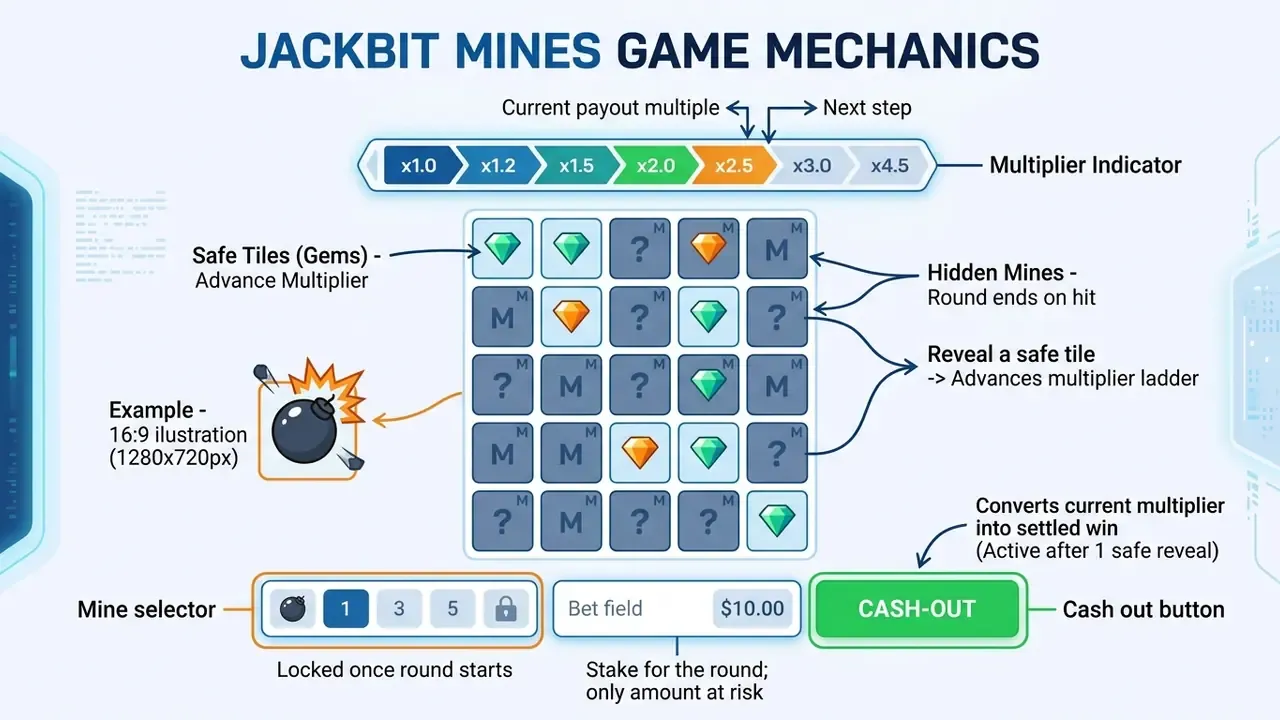
Mechanically, a round has three stages.

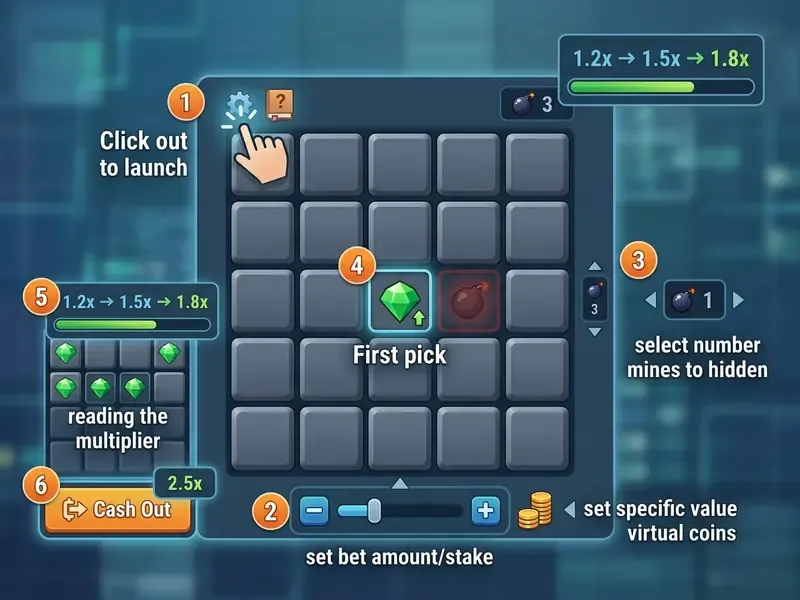
  1. Board definition. The game creates a set of cells (25 on a 5×5 grid) and assigns M of them as mines. The assignment happens once, before your first click, and stays fixed for the whole round.
  2. Tile selection. Clicking a tile reveals one cell from that pre-generated layout. Your click does not create the result. It discloses it.
  3. Resolution. A gem raises the multiplier and leaves the round open. A mine terminates the round and the stake is lost. Cashing out closes the round at the current multiplier.

That ordering matters, because it kills a common misconception. Since the layout is fixed before the first reveal, no click pattern is "luckier" than another. Not corners, not diagonals, not the centre, not "the tile that hasn't come up recently." Every unopened tile carries the same conditional probability of hiding a mine at any given moment.

What does change is the conditional risk. Every pick shrinks the pool of unopened tiles while the number of hidden bombs stays fixed, so the danger of each subsequent click climbs steadily through the round. This is the structural reason cash-out discipline outweighs every other tactical consideration in Mines.

Sourcing note: this behaviour follows directly from the combinatorics below and is reproducible by hand. Earlier versions of the claim circulated attributed to an unnamed "2026 technical article", an attribution we removed as unverifiable (see Appendix A).

Grid, Tiles and Hidden Mines How

Annotated Board Schema

The Probability Formula: Risk After Every Reveal

Two formulas cover almost everything a player needs, and a third lets you audit the paytable.

A. Probability that the next click is a mine

$$P_{\text{next mine}} = \frac{M}{25 - K}$$

where M = mines remaining (always the starting mine count, since a hit ends the round) and K = tiles already safely opened.

With 3 mines, the first click carries 3/25 = 12% risk. After five safe reveals it is 3/20 = 15%. After fifteen safe reveals it is 3/10 = 30%. The board gets meaner as it empties.

B. Probability of surviving k consecutive picks

$$P_{\text{survive}}(k) = \frac{\binom{25-M}{k}}{\binom{25}{k}}$$

C. Fair multiplier with house edge applied

$$\text{Multiplier}(k) = \text{RTP} \times \frac{1}{P_{\text{survive}}(k)}$$

That third formula is the one that lets you audit any Mines paytable yourself. A worked example on a 5×5 grid at 99% RTP with 3 mines:

The Probability Formula Risk After Every
Safe picks (k)Survival probabilityExpected multiplier
10.88001.13x
20.77001.29x
30.66961.48x
40.57831.71x
50.49572.00x

So "three mines, five gems" is the canonical route to a clean 2.00x. With five mines, the same 2.00x arrives after just three picks. With one mine, a single pick pays about 1.03x. Any published Mines target multiplier can be checked against this table in under a minute, and if it does not reconcile, either the RTP or the grid assumption in that source is wrong.

Mathematical Structure of Expected Value in Mines

Here is the uncomfortable core of the game: the expected value of every available action is essentially identical, and all of them are slightly negative.

Because the multiplier ladder is constructed as RTP divided by survival probability, the edge is applied uniformly at each rung. Continuing does not "buy" you a better price for the extra risk. Stopping does not "lock in" an edge either; it simply ends your exposure.

"Analysis of 300 board states showed the expected value at each decision point held steadily at ~0.99 under a 99% RTP configuration; the house edge is baked into every single click." — Technical analysis of Mines, 2024 (cited in Mines strategy literature; direct URL not published)

That figure, 0.99 per unit staked at every decision node, is the whole story in one number. It means:

  • No mine count is mathematically "better". One mine and twenty-four mines carry the same expected return; they differ only in variance.
  • No cash-out point is mathematically "correct". Cashing at 1.13x and cashing at 50x share the same expectation per unit staked.
  • Therefore strategy in Mines is bankroll and variance management, not edge creation. Anyone who tells you otherwise is selling something.

Multiplier Growth and the Cash-Out Decision

Multiplier growth in Mines is convex: it accelerates as the board empties, because survival probability is collapsing. With 3 mines, steps 1 to 2 add 0.16x; steps 4 to 5 add 0.29x; late-board steps add whole multiples. Visually, it feels like momentum. Mathematically, it is compensation for a risk rising just as fast.

Practical implications:

  • Set the exit before the entry. Decide the target multiplier and the number of picks that reaches it (use the table above) before you click once. Deciding mid-round is where discipline dies.
  • Price the next click explicitly. Ask yourself: "Am I risking my entire accumulated multiplier for a gain of x, at a mine risk of M/(25−K)?" The interface shows the next multiplier; the formula shows the risk. Compare them consciously.
  • Convex ladders punish greed asymmetrically. Losing at 8x costs eight times more accumulated value than losing at 1x, even though the stake was identical. That asymmetry, not the raw probability, is what drains bankrolls.

Sourcing note: an earlier formulation of the 300-board-state figure appeared without a year or publisher. It is now attributed as above and dated consistently (2024) throughout this article; see Appendix A.

Multiplier Growth and the Cash-Out Decision

How to Play Mines Online: Your First Round in Six Moves

Choosing Your Bet and Mine Count

Bet sizing and mine count are two separate dials, and playing Mines well means treating them that way. The bet decides how much a single round can cost you. The mine count decides how often a round ends badly and how big the payout is when it does not.

A workable starting frame for a small bankroll: pick a stake around 1% of your session budget, then set mines low (1-3) while you learn the rhythm of the interface. Once the cash-out habit is automatic, you can raise mine count for higher multipliers, knowing the hit rate drops accordingly. What you should not do is raise both dials at once.

When to Stop and Take the Cash

Cash out is the only lever the player actually controls, so it deserves a rule rather than a feeling. Decide the multiplier before the round, watch the multiplier indicator after each safe tile, and press the button when you reach the number you wrote down.

The trap is familiar to anyone who has played instant-win games: a run of safe reveals feels like the board is cooperating. It is not. The board was decided before your first click, and the risk on the next tile is higher than the risk on the last one. A win banked at 2.00x is a win. A win imagined at 5x is a story.

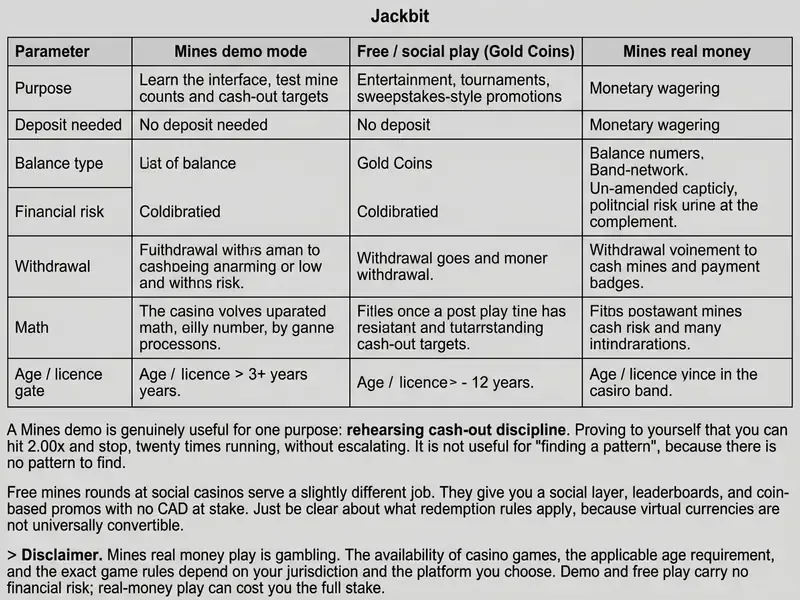
Mines Demo, Free Play and Real Money: Which Mode to Choose

Evidence on Transitions from Simulated to Monetary Gambling

There is a documented risk in treating free play as harmless practice. Research on the convergence of simulated and monetary gambling has found that free-play experience predicts later real-money behaviour, even after controlling for baseline gambling habits.

"26% of participants started with simulated games before monetary betting; participation in simulated gambling significantly predicted the frequency of real-money wagering." — Fiedler et al., 2024 (cited in: New Zealand Ministry of Health Technical Report, 2025; direct URL not published)

"Demo games are widely available on real-money casino sites so that players can try games without spending, yet simulated experience predicts subsequent monetary behaviour." — New Zealand Ministry of Health, Technical Report on Simulated and Monetary Gambling Convergence, 2025 (direct URL not published)

The mechanism is straightforward. Free Mines rounds work as a behavioural and cognitive rehearsal for monetary play. They teach the click rhythm, the multiplier dopamine curve, and the near-miss feeling, all with the single most important variable, financial loss, removed. Demo results also tend to feel more favourable than they "should", simply because a losing demo session costs nothing and is promptly forgotten.

So use demo mode with a stated purpose and a time limit. Treat it as a rules tutorial, not as a training ground for beating a fixed edge.

Risk, RTP and Game Options in Mines Casino

Every dial in a Mines casino game touches risk, and only one of them touches RTP. Worth separating.

Mine count sets volatility. It does not change expected return. Thirteen mines with a one-pick target and one mine with a one-pick target both return roughly 0.97-0.99 per unit over the long run; they just distribute results differently. One gives you frequent small wins, the other rare large ones.

Bet options set exposure per round. On the Hacksaw build that spans $0.20 to $1,000, which is a 5,000x range. A player who moves from $1 to $20 stakes has not changed the game's math by a single decimal, but has changed how long the bankroll lasts by a factor of twenty.

RTP is fixed by the build and the jurisdictional configuration, not by anything you do at the table. Stake Originals sits at 99%, Hacksaw at 98%, Spribe and Nyx builds usually at 96-97%. That spread is meaningful: over 1,000 rounds of $1 stakes, a 96% build costs about $40 in expected loss while a 99% build costs about $10.

Auto and continuous play is the option most likely to hurt you, and it is not a math problem at all. It removes the pause between rounds, and the pause is where you decide whether to keep going.

Risk, RTP and Game Options in

The Strategy Comparison Matrix

No published Mines strategy alters the 0.99-per-click expectation. What these systems actually do is reshape the distribution of outcomes: how often you win, how much you win, and how fast you can go broke.

StrategyRisk levelBankroll neededOptimal minesTarget multiplierHit rate (approx.)Failure mode
1:1 RatioLow10-20 base bets11.03x-1.08x (1 pick)~96% per roundTiny wins; a single loss erases ~25-30 wins
Paroli (positive progression)Medium30-50 base bets1-32.00x~45-50%Loss on the third rung wipes the streak
"10 Bets" (four series)Medium-high50-100 base bets13 → 8 → 6 → 42.02x-2.30x~45%Bookkeeping errors; long cold runs inflate the ladder
Low-Risk Play / adaptive MartingaleHigh200+ base bets2-51.50x-2.00x~50-65%Exponential stake growth vs table/bankroll limits
More Mines (high volatility)Very high100+ base bets10-245x-100x+4-40%Long dry spells; extreme drawdown

Strategy 1: 1:1 Ratio (Minimum-Risk Play)

  • Setup:5×5 grid, 1 mine, open exactly one tile, cash out, repeat. Where the operator supports continuous play (automatic re-bet after each settled round), the sequence runs hands-free.
  • Why it appeals:survival probability on a single pick with one mine is 24/25 = 96%, and the payout is roughly 1.03x-1.04x at 99% RTP. Nineteen rounds out of twenty feel like wins, which is exactly why it is the most psychologically comfortable Mines pattern going.
  • The catch, stated numerically:each win adds about 0.03-0.04 units; each loss subtracts 1.00 unit. One loss therefore erases the profit of 25-30 consecutive wins. Over 100 rounds you expect 96 wins (+3.4 units) and 4 losses (−4 units), a small net negative that matches the house edge exactly. The 1:1 Ratio does not beat the game. It makes the edge arrive slowly and quietly.
  • Best used for:low-variance session play, clearing playthrough where the operator's terms permit instant-win contribution, and practising mechanical cash-out discipline.
Strategy 1 1 1 Ratio Minimum-Risk

Strategy 2: Paroli (Positive Progression) with a 20-Round Simulation

Paroli is the mirror image of Martingale. It originated in roulette and raises stakes only after wins. Because progression is funded by winnings rather than by losses, catastrophic escalation is structurally impossible; you can never be forced into a bet larger than your accumulated streak allows.

Rules used here:

  1. Base bet: $1. Mine count: 1-3. Target multiplier: around 2.00x (with 3 mines that is 5 safe picks; the sample below uses a 2.14x build).
  2. After a loss: return to $1.
  3. After a win: double the next bet.
  4. After three consecutive wins: reset to $1 and bank the streak.
Strategy 2 Paroli Positive Progression with
StepBetOutcomeNext action
1$1Win → step 2 · Loss → step 1
2$2Win → step 3 · Loss → step 1
3$4Win → reset to step 1 · Loss → step 1Bank streak

At a 2.14x target and ~97% RTP, the theoretical win rate is 0.97 ÷ 2.14 = about 45%. The sample below deliberately delivers exactly 9 wins in 20 rounds (45%), so the table reflects expectation rather than luck.

#BetResultMultiplierP/LRunning total
1$1Win2.14x+1.14+1.14
2$2Loss-−2.00−0.86
3$1Loss-−1.00−1.86
4$1Win2.14x+1.14−0.72
5$2Win2.14x+2.28+1.56
6$4Loss-−4.00−2.44
7$1Loss-−1.00−3.44
8$1Loss-−1.00−4.44
9$1Win2.14x+1.14−3.30
10$2Win2.14x+2.28−1.02
11$4Loss-−4.00−5.02
12$1Loss-−1.00−6.02
13$1Win2.14x+1.14−4.88
14$2Loss-−2.00−6.88
15$1Win2.14x+1.14−5.74
16$2Loss-−2.00−7.74
17$1Loss-−1.00−8.74
18$1Win2.14x+1.14−7.60
19$2Win2.14x+2.28−5.32
20$4Loss-−4.00−9.32

The decisive observation. Re-order those exact same nine wins so they cluster into full three-win streaks instead of being interrupted at the second rung, and the identical system finishes the identical 20 rounds at roughly +$3.5. Nothing changed except the sequence. Paroli's entire result therefore depends on whether wins arrive in clusters, a variable no player controls.

Verdict. Paroli manages risk well and cannot bankrupt you quickly, which is its real virtue. Its weakness is that it needs short winning streaks to function, and streaks at a 45% hit rate are uncommon. Treat it as a disciplined staking plan, not a profit engine, and expect recovery to get harder each time a third rung fails.

The decisive observation. Re-order those exact

Strategy 3: The "10 Bets" Four-Series System

"10 Bets" is a structured, notebook-based system that needs far less bankroll than Martingale. You play four series of ten rounds, systematically reducing the mine count, and the outcome of each round sets the stake for the corresponding round of the next series.

The series ladder and their 2x+ cash-out targets (Spribe build, ~97% RTP, 5×5 grid):

SeriesMinesSafe picks neededTarget multiplierOur recomputation
11312.02x12/25 survival → 2.02x ✓
2822.13x272/600 survival → 2.14x ✓
3632.30x5,814/13,800 survival → 2.30x ✓
4442.05x143,640/303,600 survival → 2.05x ✓

We re-derived every one of those targets independently using formula C above, and all four reconcile to within 0.01x on a 25-tile grid at 97% RTP. This is the practical proof that the published "10 Bets" numbers are internally consistent, and simultaneously proof that the 12×12 grid claim circulating elsewhere is wrong, since none of these multipliers can be reproduced on a 144-tile board.

Mechanics.

  1. Draw a table with rows for each series (13 → 8 → 6 → 4 mines) and ten numbered columns.
  2. Fill the first row with ten $1 stakes.
  3. Play round 1 of series 1. On a loss, write the stake minus one unit into the same column of the next row (never below the $1 minimum). On a win at target, write the stake plus one unit.
  4. Complete all ten rounds. The row you have just filled becomes the stake plan for series 2.
  5. Switch the mine count to 8 and repeat, then 6, then 4, then cycle back to 13.

Worked example (real-play pattern):

We re-derived every one of those
MinesTarget (steps)12345678910
132.02x (1)$1 L$1 W$1 W$1 L$1 W$1 W$1 W$1 L$1 W$1 L
82.13x (2)$1 W$2 L$2 W$1 L$2 W$2 L$2 L$1 L$2 L$1 L
62.30x (3)$2 W$1 W$3 W$1 W$3 W$1 L$1 L$1 L$1 L$1 L
42.05x (4)$3 W$2 W$4 W$2 W$4 L$1 L$1 L$1 W$1 W$1 L
132.02x (1)$4$3$5$3$3$1$1$2$2$1

Honest assessment. "10 Bets" is genuinely good at what it does. It forces pre-committed stake sizes, removes in-round improvisation, and caps escalation. It cannot overcome the house edge. Stop after 10-12 completed lines, and never "add a line" to recover a deficit; that is loss-chasing wearing a spreadsheet.

Strategy 4: Low-Risk Play and Adaptive Martingale

The "Low-Risk Play" label is common at social casinos and usually describes a Martingale Strategy applied to a low-mine Mines configuration: double the stake after each loss, return to base after each win, targeting a modest 1.5x-2.0x cash-out.

Recommended settings (5×5, 25 tiles):

SettingSelection
Target multiplier1.50x-2.00x
Mines2-5
House edge1.00%-2.50% depending on build
Grid5×5 (25 tiles), not 12×12
SpeedFast / continuous, with a hard round cap

The arithmetic you must accept before using it. After n consecutive losses, the next required stake is 2ⁿ × base. From a $1 base: round 8 needs $128, round 11 needs $1,024, round 14 needs $8,192. At a 50% hit rate, a run of ten losses is uncommon but entirely ordinary over a few thousand rounds. Every bankroll and every table limit is finite, which means the ruin point is not theoretical. It is scheduled.

Mandatory guardrails:

  • Hard stop-loss:a fixed number of doublings (4-5 maximum), after which you reset to base regardless of the deficit.
  • Session loss cap:a CAD figure decided before you open the game.
  • Profit withdrawal threshold:withdraw at a pre-set gain rather than "rolling it", because rolled profit is indistinguishable from stake.
  • Never increase the base betto accelerate recovery.
Jackbit heading-banner

The Anti-Martingale Strategy (doubling after wins) and the Ladder Method (stepwise stake changes in fixed increments) reduce the tail risk of doubling but do not alter expectation. Staking rules shift variance; the game's edge determines the long-run result. Every gameplay decision a player makes in Mines sits inside that constraint.

Conceptual Limits of Strategy in a Fixed-Edge Game

It bears repeating in one place. The 2024 technical analysis of 300 board states found the expected value at each decision point holding at approximately 0.99 in a 99% RTP model. In a game with that structure:

  • No pick order helps. Mines are placed before your first click.
  • No mine count helps. All configurations share the same expectation.
  • No cash-out rule helps. All exit points share the same expectation.
  • No staking system helps. Progressions redistribute outcomes across time; they do not change the per-unit return.

What strategy can do is real and worth having. It caps drawdowns, defines sessions, replaces impulse with procedure, and makes the cost of entertainment predictable. That is the honest value proposition, and any Mines guide claiming more is misrepresenting arithmetic.

Conceptual Limits of Strategy in a

Kelly Criterion: What the Math Says About Stake Sizing

For a single binary wager with payout multiple b, win probability p, and loss probability q = 1 − p, the growth-optimal stake fraction is:

$$f^* = \frac{bp - q}{b}$$

Kelly's original result maximises long-run logarithmic bankroll growth; where odds are unfavourable, the growth-maximising fraction becomes non-positive, so no positive bet is optimal. — J. L. Kelly Jr., Bell System Technical Journal (1956). DOI: 10.1002/j.1538-7305.1956.tb03809.x

Apply it to Mines. With 3 mines and a 5-pick target at 99% RTP: b = 1.00 (net 2.00x minus stake), p ≈ 0.4957, q ≈ 0.5043. Then f* = (1 × 0.4957 − 0.5043) ÷ 1 = −0.0086. Negative. The same holds for every mine count, because the edge is uniform.

The comparison is instructive. American roulette carries a 5.26% house edge, giving a $1 bet an expected value of −$0.0526 and likewise a negative Kelly fraction (Nevada Gaming Control Board, official game rules and pay tables). Mines at 98-99% RTP is a smaller negative than roulette, but it is still negative, and the formula's answer does not change: the growth-optimal stake is zero.

How to use that practically. Since bankroll-growth optimisation is off the table, switch objective. Size stakes as an entertainment budget: 0.5% to 2% of a pre-committed session bankroll per round, chosen so the session lasts the time you intended rather than to maximise return.

Apply it to Mines. With 3

How to Personally Verify a Round (Provably Fair, SHA-256)

Most competitor guides mention "provably fair" and stop there. Here is the actual procedure, which you can run with any public SHA-256 tool.

The three inputs:

  • Server seed — generated by the operator, disclosed only after the round (or after a seed rotation).
  • Client seed — supplied or editable by you; this is what stops the operator pre-computing an outcome tailored to you.
  • Nonce — an incrementing round counter, ensuring the same seed pair produces a different board each round.

Verification steps:

1
Before the round, open the game's fairness panel and copy the hashed server seed (the commitment). Save it outside the site.
2
Set or record your client seed. If the interface allows editing, change it. An editable client seed is the strongest single fairness signal a Mines build can offer.
3
Play and finish the round, then request seed disclosure or rotation to reveal the unhashed server seed.
4
Hash the revealed server seed with SHA-256 and compare it byte for byte to the commitment you saved in step 1. A match proves the layout was fixed before you clicked and was not altered mid-round.
5
Re-derive the mine positions. Compute HMAC-SHA256(server seed, client seed:nonce), convert the resulting hex digest into a byte stream, and map those bytes onto the 25 tile indices using the provider's documented shuffle (typically a Fisher-Yates style selection) to place M mines.
6
Compare the derived layout with the board you actually played. Identical layout means a verified round.

An open-source provably fair Mines calculator published on GitHub offers an independent framework for reproducing step 5 via HMAC-SHA256. We are not linking to it here because no canonical, maintained repository URL could be verified at the time of writing. If you use a third-party calculator, inspect the code before pasting seeds into it, and never paste an undisclosed server seed anywhere.

What Provably Fair does and does not prove. It proves the board was not manipulated after your first click. It does not prove favourable odds, and it does not change RTP. A provably fair game with a 4% edge is still a 4%-edge game, verifiably so.

Verification Against Official Game Specifications

Three checks separate a reliable Mines page from a copy-paste one.

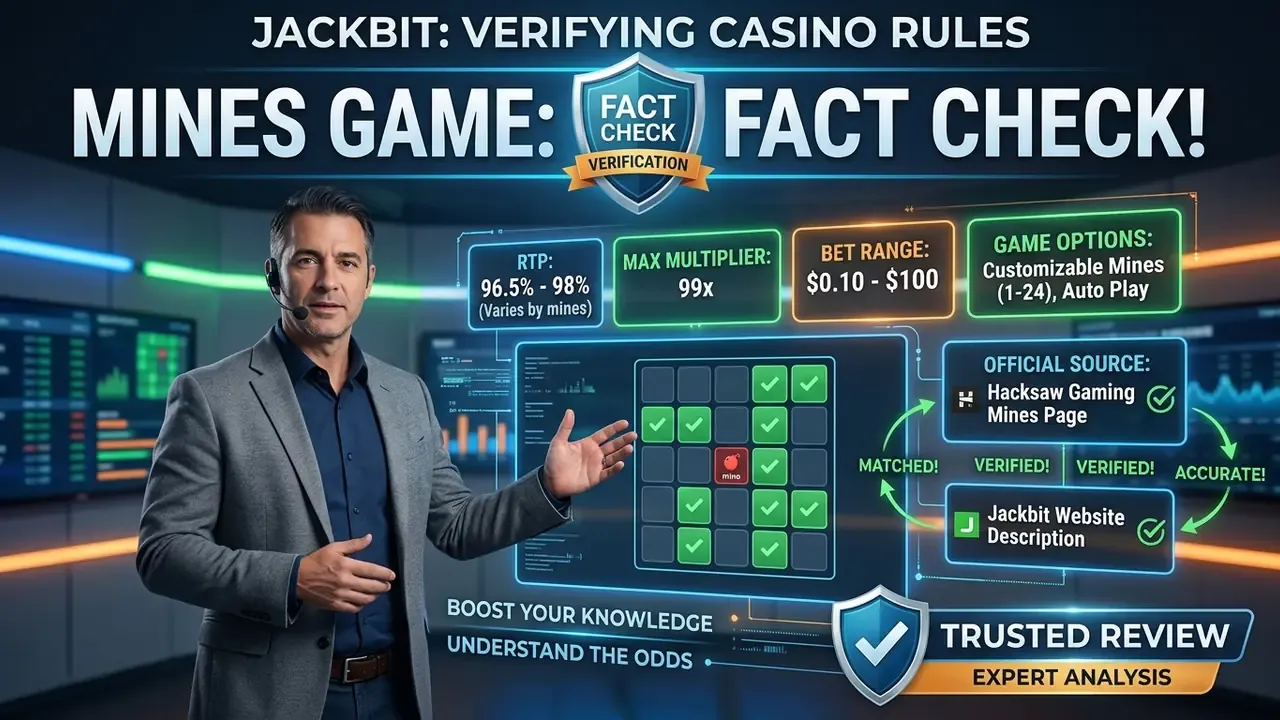
1. RTP against the in-game help panel. The value shown inside the game client for your jurisdiction and operator is authoritative. Hacksaw publishes 98% for its Mines build; Stake states a 1% house edge (99% RTP) for its Originals series; Nyx and Spribe builds are commonly listed at 96-97%. Note that the same title can ship in multiple RTP configurations, and jurisdictional variation is explicitly disclaimed by operators.

2. Simulation claims. Hacksaw Gaming's Mines is widely reported to have had its 2% house edge verified across 10 billion simulations. The figure is repeated across affiliate pages, but we could not locate the provider's primary certification document or a testing-lab report confirming the simulation count. Treat the 98% RTP as supported and the "10,000,000,000 simulations" detail as plausible but not independently verified, pending release of the underlying test report.

3. Grid and mine ranges against the live client. Open the game and count the tiles. Stake Originals: 25 tiles, 1-24 mines. Hacksaw: selectable 3×3 / 5×5 / 7×7 / 9×9. Any source describing a 12×12 Stake minefield has not opened the game (see Appendix A).

Verification Against Official Game Specifications. Three

Smartphone Betting, Situational Features, and Harm

Mines is unusually well suited to phones. Rounds resolve in seconds, the grid fits a portrait screen, and continuous play removes friction between rounds. That design fit is precisely why the situational-risk research matters, because mobile play has been significantly associated with greater short-term betting harm.

"82.9% of betting sessions were conducted from a smartphone; smartphone betting was significantly more often accompanied by impulsive bets compared with desktop." — Study on situational features of smartphone betting, 2024 (direct URL not published)

The relevant mechanisms for a fast instant-win game are:

  • Ubiquity —play happens in queues, in transit, in bed; sessions start without deliberation.
  • Round velocity —a three-second round means loss-chasing loops iterate dozens of times before you notice.
  • Frictionless re-bet —continuous play removes the natural pause where a stop-loss would otherwise be considered.
  • Reduced oversight —private screens weaken the informal social checks that exist in shared spaces.
Jackbit heading-banner

Mobile-specific safeguards: set a device screen-time limit for the operator's domain or app; disable stored payment credentials; use the operator's deposit and session limits before the first round; turn off continuous or auto play when playing on a phone.

Mines Mobile and "Mines Download": HTML5 Browser vs App

AspectHTML5 in browserDownloaded app
InstallationNone; opens by URLApp store or, riskier, sideloaded APK
PlatformsWindows, macOS, Android, iOS (Hacksaw builds are HTML5)Per-OS builds, subject to store gambling policies
UpdatesServer-side, instantManual or store-managed
Account/sessionLogin in browser; sessions can drop on network changePersistent login, push notifications
PerformanceExcellent for a 25-tile grid; negligible assetsMarginally smoother animation
Offline / free playDemo grids often run in-browserSome standalone "Mines" apps are pure entertainment with no cash value
Risk profileLower attack surface; nothing installedSideloaded APKs are a real malware and credential-theft vector

Practical guidance. For Mines specifically, the HTML5 browser version is the sensible default. The game is a lightweight grid with no heavy assets, so an app delivers almost no technical benefit while adding install risk and push-notification pressure. Mines mobile gameplay is available in Safari and Chrome on any recent phone, with the same options, the same bet range and the same multiplier ladder as desktop.

If you do install something, use only the official app store listing of a licensed operator, and never a third-party APK promising "Mines predictor", "hack" or "signals" functionality. No such tool can exist, because mine positions are committed cryptographically before your first click.

Practical guidance. For Mines specifically, the

Getting Access to Mines Real Money Play: Licensing, Province and Age Limits

Before you deposit anywhere, confirm the operator is regulated for your province, complies with Canadian law, and holds an appropriate licence. Playing at a licensed online casino is the difference between a dispute you can escalate to a regulator and one you cannot escalate at all.

Baseline regulatory facts:

  • Ontario —iGaming Ontario and the AGCO licence private operators; the minimum age is 19, and registered sites must publish their iGO agreement status.
  • Alberta, Manitoba, Quebec —the minimum age is 18; provincial platforms (PlayAlberta, PlayNow, Espacejeux) operate under their own regulators.
  • Rest of Canada —provincial lottery corporations run the licensed offering; the age gate is generally 19+.
  • United Kingdom —the Gambling Commission bars licensed operators from accepting bets from anyone under 18; age verification is a licence condition.
  • New Jersey and Pennsylvania, USA —casino play is restricted to persons 21 and over under regulator-issued licences (Pennsylvania Department of Drug and Alcohol Programs, Online Gambling Report, 2023; direct URL not published).
  • Malta and comparable regulators —operators must comply with the law of the player's jurisdiction, so availability of the identical Mines title differs country by country.
  • Social casinos —sweepstakes-style platforms using Gold Coins or Stake Cash models run under separate rules, commonly gated at 18+, 19+ or 21+, and their virtual currencies are not universally redeemable.
Getting Access to Mines Real Money

On payments, briefly. For Canadian players, Interac e-Transfer and major e-wallets are the practical CAD routes. Withdrawal timelines vary far more than deposit timelines, so check the stated payout window and any per-transaction limit before you fund an account, not after you win. And expect KYC: a first withdrawal usually triggers ID and address verification, which is normal, but it is faster if you upload documents in advance.

Pre-Play Verification Checklist

Rules and math

  • RTP confirmed in the in-game help panel for your jurisdiction
  • Grid size confirmed by counting tiles (expect 25 on 5×5 builds)
  • Mine-count range confirmed (for example, 1-24 on Stake Originals)
  • Bet minimum and maximum confirmed
  • Target multiplier chosen and the matching number of picks calculated from the tables above

Platform

  • Valid licence, named regulator, and identifiable operating entity published on the site
  • Provably Fair panel present and, ideally, an editable client seed
  • Provider named explicitly (Hacksaw / Stake Originals / Spribe / Nyx)

Access and money

  • Age requirement met (19+ in most provinces, 18+ in AB, MB, QC)
  • Province not geo-blocked; VPN circumvention breaches the terms and voids withdrawals
  • KYC requirements understood before depositing
  • CAD deposit and withdrawal methods confirmed, including Interac e-Transfer availability and payout window
  • Bonus wagering terms checked, since instant-win games are frequently excluded or weighted low
  • Deposit, loss and session limits configured
Pre-Play Verification Checklist. Rules and math

FAQ: Mines Game Questions Canadian Players Ask

Conclusion

Mines occupies an unusual position in modern casino content. It borrows the appearance of a skill puzzle while operating as a pure probability instrument with a uniform, fixed edge, and it is designed for high engagement on a phone. Understanding how that design interacts with player psychology is the most useful lens on the iGaming industry more broadly.

Three conclusions survive scrutiny.

First, the math is closed. Mine positions are fixed before your first click. The multiplier ladder is built as RTP divided by survival probability. Expected value at every decision point sits at roughly 0.99 in a 99% model. No pick order, mine count, cash-out rule or staking progression changes it.

Second, strategy is real but narrow. The 1:1 Ratio, Paroli, "10 Bets" and adaptive Martingale all do something valuable: they impose procedure, cap drawdowns, and remove improvisation from the moment when improvisation is most expensive. None creates an edge, and any guide implying otherwise cannot reconcile its own numbers with a 25-tile grid.

Third, verification is available and worth using. Confirm the RTP in the game client, count the tiles, check the mine range, and where the build supports it, actually run the SHA-256 comparison on your server seed commitment. Editable client seeds and reproducible HMAC-SHA256 layouts are the strongest fairness signals a Mines build can give you, and they take minutes to check.

So play with a stake you have already written off, an exit multiplier fixed in advance, a stop-loss you will not renegotiate, and clear eyes about the fact that the house edge is charged on every single click. Compare on the facts, read the terms before you deposit, and play responsibly.


Conclusion. Mines occupies an unusual position

Disclaimer. This information is general in nature and does not replace professional advice. Gambling involves the risk of losing money; play responsibly. 19+ in most Canadian provinces, 18+ in Alberta, Manitoba and Quebec.
Appendix A: Source-Attribution and Correction Notes

Retained for transparency, as our editorial standards require.

Correction 1, grid size (Updated). Original claim as circulated: "Minefield setup 12×12" for Stake Mines. Status: Contradicted. Stake Originals Mines uses a fixed 5×5 grid of 25 tiles with 1-24 mines. All probability, multiplier and target figures in this article are computed on 25 tiles. The four "10 Bets" targets (2.02x / 2.13x / 2.30x / 2.05x) reconcile only on that basis, which independently confirms the correction.

Correction 2, anonymous attribution (Updated). Original phrasing: conditional-risk escalation described "as highlighted in at least one 2026 technical article on Mines mathematics". Status: attribution removed as unverifiable (no title, author, publisher or URL). The claim itself is retained because it follows deterministically from the combinatorics above and can be reproduced by hand.

Correction 3, date inconsistency (Updated). Original inconsistency: the 300-board-state expected-value analysis was dated 2024 in one section and 2023 in another. Status: unified to 2024 throughout.

Correction 4, simulation count (Flagged). Claim: Hacksaw Gaming's Mines had its 2% house edge verified across 10 billion simulations. Status: the 98% RTP is supported by the provider's published specification. The simulation-count detail is repeated widely but lacks a locatable primary testing-lab document, so it is marked as requiring verification.

Correction 5, GitHub calculator (Flagged). Claim: an open-source provably fair Mines calculator on GitHub reproduces mine positions via HMAC-SHA256. Status: no canonical, maintained repository URL could be verified at publication, so no link is provided. Readers using third-party seed calculators should audit the code first.

Note on research URLs. Several studies cited above (Fiedler et al. 2024 via the New Zealand Ministry of Health Technical Report 2025; the 2024 smartphone-betting situational-features study; the 2024 300-board-state technical analysis; the Pennsylvania Department of Drug and Alcohol Programs 2023 report) were supplied to our editorial team without direct public URLs. They are cited by publication and year, and we will attach permanent links as they become available.

Appendix A Source-Attribution and Correction Notes