Book of Dead Slot Review 2026: RTP Builds, Full Paytable Math, and a Documented 50-Spin Test

Last updated: February 2026 · Reviewed by the iGaming editorial desk (see our iGaming case studies and methodology)
Provider

Play'n GO

RTP

96.21%

Volatility

High

Min bet

$0.10

Max bet

$100

Max win

5,000x the total bet

Book of Dead Slot Review 2026

Everything That Matters in 60 Seconds

Book of Dead is a 5x3, 10-adjustable-payline slot released by Play'n GO on 14 January 2016, built around explorer Rich Wilde and an ancient-Egypt expedition theme. Its default RTP is 96.21%, volatility is high, and the maximum win is 5,000x the total bet. The single bonus engine is a 10-free-spin round with one randomly chosen expanding symbol, plus an optional Gamble round after base-game wins.

Here is the detail most reviews bury. Play'n GO ships Book of Dead in multiple RTP builds, and the operator picks which one to run. On a 94.25% build your bankroll burns roughly 40% faster than on the 96.21% build. On the worst reported configurations (87.25%), the cost climbs sharply. This review gives you the exact math, a four-step method to verify which build your casino installed, the full paytable, a documented 50-spin session, and the bonus-wagering formulas that decide whether an offer is playable at all.

Everything That Matters in 60 Seconds

Responsible gambling note: the information below is general in nature and does not replace professional advice. Gambling carries a risk of financial loss. Play only if you are 19+ in your province. If you are experiencing gambling-related problems, seek professional help.

Why This Review Matters if You Play From Canada

Most Canadian players find Book of Dead the same way: a brand search, a lobby scroll, then a quick decision on mobile. Fair enough. But the version of the slot you open is not a fixed product, and that changes the value of every dollar you stake.

Three things decide whether this game is worth your session budget here. First, licensing: Ontario residents play on sites regulated by iGaming Ontario / AGCO, while players in other provinces usually land on MGA or Kahnawake licensed operators. Second, money movement: deposits and withdrawals in CAD through Interac e-Transfer or an e-wallet, because a fast payout rail is worth more than a flashy welcome banner. Third, the RTP build, which no marketing page will volunteer.

You can verify all three before you deposit. That is the whole point of the checks below.

Why This Review Matters if You

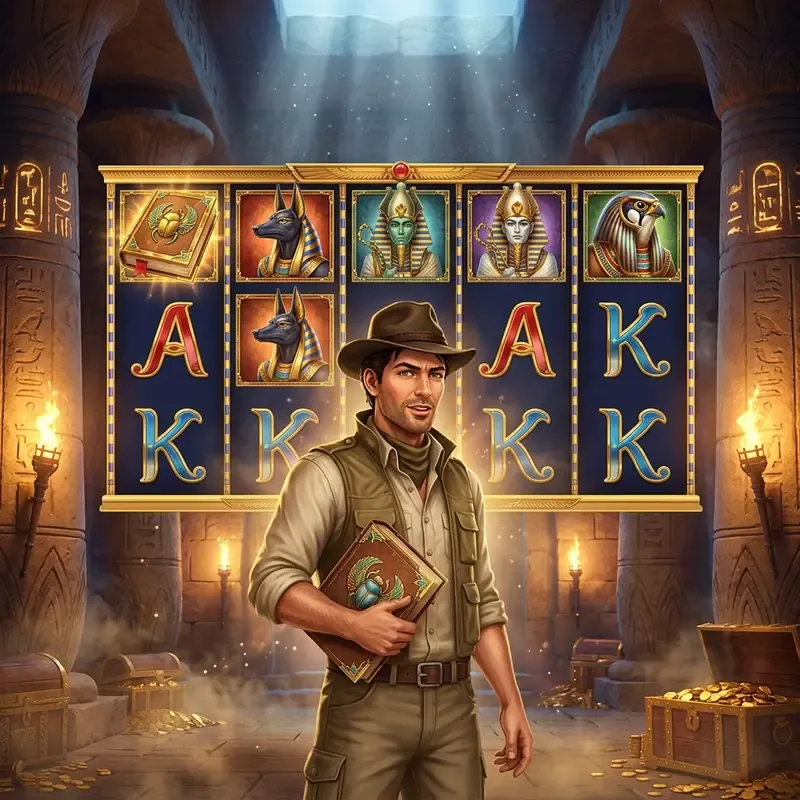
Rich Wilde and the Egyptian Theme

The reels sit inside a torch-lit tomb wall, framed by hieroglyphic columns and desert gold. Rich Wilde, a deliberately Indiana-Jones-shaped explorer who later became Play'n GO's flagship character across a whole series, appears as the top-paying symbol alongside Osiris, Anubis and Horus. The audio is a slow, low-register score punctuated by stone-scrape and coin effects. It frames the game as an expedition into a sealed chamber rather than a carnival-style slot machine.

Let me be careful about causation. The ancient-Egypt motif is one of the most reused themes in the entire slot category, and no published dataset isolates theme as the driver of this game's retention. What can be said with confidence: the title holds long-running commercial visibility without licensed intellectual property, leaning on an in-house character and a public-domain mythological setting. That design choice keeps distribution costs low and lets the slot launch in almost every regulated market. Any stronger claim about why players return would need engagement telemetry that providers simply do not publish.

Rich Wilde and the Egyptian Theme

Benchmark Status Across Online Casinos

Rather than asserting a market share nobody can verify, the accurate formulation is this. Book of Dead is consistently listed among Play'n GO's most widely distributed and most frequently reviewed slot games, and it appears in the standard lobby of the large majority of licensed operators. In practice it works as a benchmark title: reviewers and players use it as the reference point for book-style mechanics, and operators treat it as a default part of the product mix. That is why you will find it in nearly every online casino lobby you open. Quantified share-of-wallet or active-player figures are not public, so treat them as unknown rather than assumed.

The lineage runs back to Novomatic's Book of Ra (5 reels, 9 lines, a simpler base game). Book of Dead added a tenth adjustable payline, sharper high-symbol weighting and a higher-variance bonus engine. Then it became the template dozens of later "Book of..." clones copied, sometimes down to the animation timing.

Benchmark Status Across Online Casinos. Rather

Core Parameters and Specification Card

Multimedia placeholder: specification table. A compact Book of Dead card with provider, theme, reel format, RTP, volatility, bet range, max win and key bonus features. Semantic table with caption, header and body; every value explained in text beneath the table.

ParameterValueNotes
ProviderPlay'n GORelease date: 14 January 2016
Grid / paylines5x3 / 10 adjustable linesSelectable from 1 to 10
VolatilityHighInfrequent but larger payouts
RTP range94.25% to 96.21% (87.25% reported in some markets)Depends on the operator's licensed build
Min. / max. bet$0.01 / $100Coin denomination 0.01 to 2.00, 1 to 5 coins per line
Maximum win5,000x total bet$500,000 at max bet
Bonus round10 free spins plus expanding symbolRetriggerable with 3+ scatters
Gamble featureYes (colour 2x / suit 4x)Base-game wins only
Bonus buyNoSee the fact-check below
PlatformHTML5, desktop plus iOS/Android browserNo native app required

Read that table as a risk profile, not a sales sheet. A 5x3 grid with only 10 lines means fewer, chunkier wins than a 243-way or cluster slot. The min bet of $0.01 per line makes the game accessible at $0.10 a spin, while the max bet of $100 exists mainly to make the 5,000x headline sound bigger.

The probability of actually reaching that 5,000x ceiling is often quoted as roughly 1 in 3,750,000 spins. Note the caveat: this is an analytical estimate published by Funbet (2026) based on symbol combinatorics, and the full derivation has never been released by the provider. Treat it as an order-of-magnitude indication of rarity, not an audited figure.

Read that table as a risk

Symbols and the Complete Paytable

Ten symbols in total: five card ranks (10, J, Q, K, A), four Egyptian premiums (Horus, Anubis, Osiris, Rich Wilde) and the golden Book, which is simultaneously wild and scatter. Wins pay left to right from reel one. Card symbols need at least three on a line. The premium symbols, and this is the important structural detail, start paying from just two on a line, which is what gives the base game its trickle of small returns.

The Book as Wild and Scatter

One symbol does two jobs. As a wild, the Book substitutes for every other symbol to complete winning combinations on a line. As a scatter, it pays from any positions on the reels and, at three or more, opens the free spins round. Five Books on a line return 200x, which is respectable but not the reason you want them; the round they unlock carries the real upside.

Because the same image handles substitution and triggering, near-misses feel loaded. Two Books on screen with a third teasing on reel five is the game's signature moment of tension. It is also, statistically, just a blank spin.

Regular Symbols and Their Ranking

Symbol2 on a line3 on a line4 on a line5 on a lineRole
Rich Wilde (Explorer)10x100x1,000x5,000xTop symbol, pays from 2
Osiris (Pharaoh)5x40x400x2,000xPremium
Anubis / Horus5x30x100x750xPremium
Book of Dead (wild + scatter)n/a2x20x200xTriggers 10 free spins, substitutes for all
A, Kn/a5x40x150xLow pay, from 3
Q, J, 10n/a5x25x100xLow pay, from 3

Reading the paytable correctly. Published coefficients differ between sources because some are quoted per coin per line and others relative to total bet. On a per-single-coin basis you will see Rich Wilde at 500x, Osiris at 200x, Horus and Anubis at 75x and the Book at 20x for five of a kind. The table above expresses the same paytable at the higher coin-per-line configuration that produces the headline 5,000x ceiling. Always cross-check the in-game paytable at your operator: the ratios between symbols stay identical, only the multiplier base shifts.

One practical consequence. The gap between four and five Rich Wilde symbols (1,000x to 5,000x) is where almost all of the theoretical top end lives. Four of a kind is a good spin. Five is a different category of event.

Reading the paytable correctly. Published coefficients

Free Spins, the Expanding Symbol and the Gamble Feature

How the Free Spins Round Triggers

Three or more Book scatters anywhere on the reels award 10 free spins, and the count does not change whether you land three, four or five. Before the round begins, the game randomly selects one symbol to become the special expanding symbol.

Landing 3+ scatters during the round retriggers the feature and adds another 10 spins. There is no cap published on retriggers, which is where the long-tail sessions come from.

The Expanding Symbol During Free Spins

Here is the mechanic that makes the free spins feature volatile. When the chosen symbol appears and forms part of a winning combination, every instance in view expands to cover its full reel. Expanded symbols pay without needing to sit on adjacent reels in the usual left-to-right sense, so scattered coverage across the grid still resolves as a win.

Draw Rich Wilde as the expanding symbol and a near-full-screen expansion is where the 5,000x scenarios live. Draw the 10 and the round will usually return less than a mid-sized base-game hit. Same trigger, wildly different outcomes. That single random draw, not your bet size, decides the ceiling of the round.

The Expanding Symbol During Free Spins

Gamble Feature: Rules and Real Math

After any base-game win, a Gamble button appears. Two choices:

  • Guess the card colour (red or black): success probability 50%, win multiplied 2x.
  • Guess the suit (spades, hearts, diamonds, clubs): success probability 25%, win multiplied 4x.

A wrong guess wipes the entire win for that spin. You may gamble up to five times in a row. The expected value of either option is exactly neutral before the operator's configured RTP is applied. The gamble feature does not beat the slot; it converts a small certain win into a smaller chance at a larger one, widening session variance in both directions. In practice, the suit option is only defensible on trivially small wins, where losing the amount changes nothing about your session plan.

Gamble Feature Rules and Real Math

Fact-Check: There Is No Book of Dead Bonus Buy

Several widely read pages describe a "book of dead demo with bonus buy" and explain how to purchase free spins. That is incorrect for the original Play'n GO title. Book of Dead ships without a feature-buy mechanic; free spins are obtainable only by landing three or more scatters. Pages showing a buy button are third-party demo wrappers, unlicensed clones, or a confusion with other providers' feature-buy slot games. In several jurisdictions, feature-buy is prohibited outright. If a lobby offers you a bonus buy on this slot, treat the software's authenticity as unverified and close the tab.

Alert: free spins, the expanding symbol and any gamble feature do not guarantee a win. Set a stake limit and a loss limit before you spin, and stop when you reach either. RTP, max win and bonus rules should always be cross-checked against Play'n GO's official game information and the rules published by your specific online casino.

RTP Builds, Volatility and Realised Returns

Official RTP, Configurable Versions and House Edge

Play'n GO's published default is 96.21%, marginally above the 96% industry midpoint. The corresponding house edge is 100% minus 96.21%, so 3.79%. The reduced build most commonly seen in the wild is 94.25%, a house edge of 5.75%. That is a 1.96-percentage-point difference in RTP, but a 52% increase in the operator's edge per spin.

RTP figures are theoretical long-run values and do not guarantee outcomes in any individual session. The actual RTP in force depends on the specific operator.

Where Is the Catch in Book of Dead RTP Ranges?

Play'n GO supplies the slot in several RTP versions, from the reference 96.21% down to trimmed 94.25% builds and lower. The gap looks cosmetic on the page. For your balance it is not.

Simulation at a $100 deposit and $1 per spin:

  • 96.21% build (house edge 3.79%): Spin budget = $100 / 0.0379 = 2,639 spins At roughly 3 seconds per spin, about 2 hours 12 minutes of play.
  • 94.25% build (house edge 5.75%): Spin budget = $100 / 0.0575 = 1,739 spins About 1 hour 26 minutes of play.

Result: on the trimmed build your bankroll burns 40.2% faster, and because free-spin triggers are a function of spins taken, your number of chances at the bonus round drops proportionally. This is the single most consequential number in the review, and it is invisible on screen. Graphics, animations and paytable are byte-identical between builds.

A useful analogy: RTP builds are to slots what rule variations are to blackjack. One casino pushes on a dealer 18 and returns your stake, another takes the pot. In blackjack the difference is printed on the felt. In a slot game it hides in the math under the artwork.

Where Is the Catch in Book

Community-Tracked Realised RTP and Hit Frequency

Player-side tracking gives a helpful reality check on theoretical numbers. The aggregated dataset cited in several 2026 reviews covers 8,317,134 tracked spins.

"Analysis of over 8 million real wagers showed a realised RTP of approximately 93.8% and a hit frequency of about 26%." SlotTracker, Book of Dead community dataset (2026). https://slottracker.com/slots/book-of-dead

Two readings follow. First, a realised 93.8% across millions of tracked spins is consistent with a mixed population of 96.21% and reduced builds, not with the headline figure alone. Second, a hit frequency near 26% means roughly three in four spins return nothing. That is the lived texture of high volatility for a player sitting at the screen.

Volatility Classification, Max Win and Distribution

The provider classifies Book of Dead as high volatility, although some review databases still list it as medium. That inconsistency is worth knowing, because it changes the bankroll assumptions a reader might make. The paytable explains the classification: premiums paying from two symbols create frequent micro-returns, while the whole upper tail sits inside the expanding-symbol round. Notably, no 5,000x cap hit was recorded across those 8.3 million tracked spins, which underlines how theoretical the ceiling is. No peer-reviewed source independently confirms the commonly quoted 1-in-3,750,000 figure either, so treat it as an estimate.

The 10 paylines adjust from 1 to 10, and a stubborn misconception says fewer lines improve your odds:

Volatility Classification, Max Win and Distribution

"On modern multi-line EGMs, the number of lines selected affects only return volatility, not long-run chances of winning." Journal of Gambling Studies, "Skill-based EGMs" (April 2024). https://link.springer.com/article/10.1007/s10899-024-10295-6

In other words, adjustable paylines change how wins are distributed without touching long-run RTP. One line at a high coin value and ten lines at a low coin value produce the same expected return at the same total stake. Only the shape of the distribution changes.

Casino Implementation, RTP Variants and Regulation

Deployment in the UK, Canada and Other Markets

Independent auditing of live operator builds shows how far real deployments drift from the marketing figure. The typical Book of Dead RTP in UK casinos in 2026 is 94.25%.

"The typical Book of Dead RTP in UK casinos in 2026 is 94.25%; individual operators reduce it as far as 87.25%." RTPTrack UK Audit (2024 to 2026). https://rtptrack.co.uk/slots/book-of-dead/

The instruction is blunt: do not assume the advertised 96.21% applies at your chosen casino. Verify it inside the game client, and prefer licensed casinos that publish the active build. For Canadian readers, the relevant frames are iGaming Ontario / AGCO for Ontario residents, plus MGA and Kahnawake licences for offshore-facing operators serving other provinces. Licence status governs dispute resolution and payout enforceability. It does not guarantee a high-RTP build, which is a separate commercial configuration entirely.

Session Length and Expected Loss Across RTP Tiers

The cost of a trimmed build scales linearly with turnover, which is why it compounds quickly on a high-volatility slot. Independent slot-mathematics work quantifies the worst case.

"Reducing RTP from 96.21% to 87.25% costs players approximately £127.50 in additional losses per 1,000 £1 wagers." OLBG Slot Mathematics Analysis, cited by Jackbit (2026). https://www.olbg.com/slots/book-of-dead

RTP buildHouse edgeExpected loss per 1,000 x $1 spinsSpins from a $100 bankroll
96.21%3.79%$37.90~2,639
94.25%5.75%$57.50~1,739
87.25%12.75%$127.50~784

Read the right-hand column as playing time, because that is what you are actually buying.

How to Verify the Real RTP in Four Steps

  1. Log in to the casino. Never check RTP in demo mode or while logged out. Unauthenticated sessions default to the 96.21% version regardless of what the operator actually runs.
  2. Launch Book of Dead in real-money mode. The configured build is only exposed in cash play.
  3. Open the information menu. Tap the padlock, the "i" or the "?" icon (usually bottom-left) and page through to the rules.
  4. Find the line reading "The theoretical return to player (RTP) for this game is...". If it says 94.25%, or anything lower, switch casino. The game looks identical; your expected losses are not.

Multimedia placeholder: annotated screenshot. The Book of Dead play screen with labels for bet size, spin button, balance, settings and the information menu. Alt text should include the phrase "book of dead play", and every label from the screenshot must be duplicated as text in the page body.

How to Verify the Real RTP

How RTP Is Communicated, and Why Wording Changes Behaviour

RTP Labels, House-Edge Labels and Perceived Chances

Disclosure format matters as much as disclosure itself. In large experimental work, participants rated their perceived chances of winning as significantly higher with a typical 90% RTP message than with no information at all.

"Participants rated their chances of winning significantly higher when shown an RTP label than with no information, with an odds ratio above 5." Weiss-Cohen et al., Journal of Gambling Studies (2023 to 2024), N = 6,062. https://link.springer.com/article/10.1007/s10899-023-10255-6

The same research programme shows that mathematically equivalent labels are not cognitively equivalent. The house-edge phrasing was understood by a clearly larger share of gamblers:

"The house-edge label was understood by 66.5% of participants (95% CI 60.0 to 73.0%), whereas the equivalent RTP label was understood by only 45.6% (95% CI 38.8 to 52.4%)." Weiss-Cohen et al., "Equivalent gambling warning labels are perceived differently" (2024). https://link.springer.com/article/10.1007/s10899-023-10255-6

Applied here, the honest translation of "96.21% RTP" is this: the house keeps 3.79 cents of every dollar wagered, on average, over the long run. On a 94.25% build, 5.75 cents. Same slot, different price of admission.

Do Experienced Players Pick Better Odds?

According to a secondary summary of research by Hu and Shoemaker published on PrimeCasino (2024), more experienced players tend to select machines with better odds. The original methodology has not been verified, and no peer-reviewed version was accessible for this review, so treat the direction as plausible but preliminary. No data on effect size.

What follows is still actionable, and any reader can test it. Because this slot exists in several builds, an informed player's first optimisation is not strategy inside the game (there is none, outcomes are RNG-determined) but build selection between casinos. Experienced players may reasonably prefer verified 96.21% deployments, or alternative high-RTP online slots, over trimmed versions of the same title. How often players actually run that check is unknown.

Do Experienced Players Pick Better Odds

Book of Dead Demo, Free Play and Real Money

What the Free Demo Actually Gives You

The free version runs the same math model, the same paytable and the same bonus features as the cash game. You can play the demo slot to learn the interface, watch the expanding symbol resolve, test the gamble feature and see how often two scatters tease a third. Credits are virtual, carry no cash value, cannot be withdrawn and usually reset on reload.

There is one decisive exception, and it matters: demo sessions default to the highest RTP build. So a Book of Dead demo cannot tell you what your casino runs. Use free play to learn mechanics, never to calibrate expectations about payout frequency.

What the Free Demo Actually Gives

What Changes on Real Money

Moving to real money introduces deposit processing, KYC verification, financial exposure on every spin, and withdrawal rules (limits, timeframes, method restrictions) that must be read before the first deposit rather than after the first win. Bonus terms attach here too, and so does the operator's chosen RTP version. In Canada, this is also where payment reality bites: an Interac e-Transfer withdrawal that clears in hours behaves very differently from a card refund sitting in a five-day queue.

One small habit saves a lot of grief. Complete verification while your balance is boring, not on the day you finally hit a decent win.

What Changes on Real Money. Moving

Free Spins as Salient Events and Session Endings

Bonus events do not only pay. They change behaviour. In an online EGM experiment, participants who received early free spins quit sooner, placing significantly fewer bets than the control group.

"Participants who received free spins early in the session placed significantly fewer bets and ended play earlier than the control group." "Free Spins Spur Gamblers to Quit EGMs Early: An Online EGM Study" (2019). https://doi.org/10.1007/s10899-018-9775-5

For a slot whose entire upside sits in one bonus round, that is worth internalising. An early trigger can work as a natural, and financially sensible, stopping cue.

Simulated Gambling, Social Casino and Harm

Demo play is usually presented as risk-free. Financially, within the session, it is. Behaviourally the evidence is less comfortable.

"Lifetime engagement in almost all forms of simulated gambling was associated with monetary gambling engagement and gambling problems." "Order of first-play in simulated versus monetary gambling", PMC (2024). https://www.ncbi.nlm.nih.gov/pmc/articles/PMC10896543/

Two cautions on interpretation. This is an observational finding, so association is not causation and the direction of influence is not established. The reasonable conclusion is therefore weaker than the popular framing: demo play may correlate with real-money engagement, but nothing in the cited literature demonstrates that free play causes later harm.

Editorial Test Drive: 50 Spins in Book of Dead

Documented session on a verified 96.21% build, real money, logged by Reid Calloway, independent casino analyst (editorial persona) for our Canadian desk.
  • Starting balance:$100
  • Base bet:$0.50 across 10 active lines
  • Spins 1 to 20:four winning combinations, all low symbols (10, J). Balance down to $91.50, textbook high-variance drift.
  • Spin 24 (gamble):three Q symbols paid $1.25. Risk round taken: colour guessed correctly (red) for $2.50, then suit guessed correctly (spades) for $10.00. Balance back to $100.25.
  • Spins 25 to 40:bet raised to $0.60 to test whether stake size changed the felt rhythm of hits. It did not, as expected; hit frequency is stake-independent.
  • Spins 41 to 50:two scatters landed twice, the third never arrived. Bonus round not triggered in 50 spins.
  • Closing balance:$84.00 (net minus $16.00 on roughly $27 of turnover)
Editorial Test Drive 50 Spins in

Takeaway from the desk: with a hit frequency near 26%, 50 spins is far too short a window to expect a bonus trigger. The free spins round is the only meaningful source of upside, and reaching it reliably takes hundreds of spins, which is exactly why the RTP build matters more than any in-game decision. The gamble feature is the one lever that can offset base-game drift, but the 25% suit option is only rational on small wins. Here, the 50% colour option preserved the balance and nothing more. Honest summary: an unremarkable session, and unremarkable is the norm.

How to Play Book of Dead: 10 Steps for Newcomers

1
Choose a licensed casino. AGCO / iGaming Ontario for Ontario, MGA or Kahnawake for other markets. Verify the licence number on the regulator's register, not just the footer logo.
2
Confirm the software is genuine Play'n GO, and that there is no bonus buy button, which is a red flag for clones.
3
Register and complete KYC early. Identity verification before your first withdrawal request prevents payout delays.
4
Deposit with a method you can also withdraw to. In Canada, Interac e-Transfer and e-wallets are typically the fastest routes back out in CAD.
5
Open the slot in real-money mode and check the RTP using the four-step method above.
6
Set the coin denomination (0.01 to 2.00) and coins per line (1 to 5). Watch the total bet field, not the coin value.
7
Select active paylines (1 to 10). Keep all 10 active unless you specifically want higher variance per line. Total stake, not line count, governs expected return.
8
Spin manually first, then use autoplay with loss limits if your client offers them.
9
Decide in advance whether you will use gamble, and cap it at one step. Chase nothing after a win.
10
Set a session loss limit and a time limit before you start. This game's variance is built to test both.

Where to Play: Assessing the Casino and the Bonus Offer

Which Bonus and Free Spins Terms to Compare

  1. Wagering requirement: look for 30x to 35x or lower. Above 40x, clearing a bonus on a high-volatility slot is mathematically implausible for most bankrolls.
  2. The wagering formula is the trap. Avoid terms that apply wagering to (deposit + bonus). Example: deposit $100, bonus $100, wagering 30x. On bonus-only terms you must turn over $3,000. On (deposit + bonus) terms you must turn over $6,000, double the exposure for an identical headline offer.
  3. Max bet during wagering is usually capped at $5. One larger spin can void the entire bonus and every dollar attached to it.
  4. Max cashout caps. A no-wagering offer with a $50 withdrawal cap is often worth less than a 30x offer with no cap. Rule of thumb: the more spectacular the headline, the more sceptically you should read clause 7.
  5. Non-sticky (parachute) bonuses are the player-friendly structure. Your deposit stays withdrawable, and the bonus only activates once the cash portion is spent.
  6. Game weighting and expiry. Confirm that Book of Dead contributes 100% to wagering, and check the clearing window. Seven days is aggressive, 30 is workable.
  7. Payout logistics. Verify withdrawal processing times in CAD for Interac and e-wallets, plus any weekly cap, before you deposit.
Which Bonus and Free Spins Terms

Why the RTP Version Beats the Bonus Size

Say two casinos both offer 100 free spins on this slot. One runs the 96.21% build, the other 94.25%. Over 1,000 subsequent $1 spins of your own money, the difference in expected loss is $19.60. That gap quietly outweighs a lot of promotional generosity, and it repeats on every thousand spins you play afterwards.

So the order of checks is: licence, then RTP build, then withdrawal rails, then the bonus. Not the reverse.

Pre-Registration Checklist

Multimedia placeholder: casino selection checklist rendered as a semantic list with interactive checkboxes; the full text of each item must be readable without JavaScript.

  • Valid, verifiable licence for your province or market
  • Genuine Play'n GO software, no feature-buy on Book of Dead
  • Active RTP build shown in the game's info screen (96.21% preferred)
  • Full bonus terms published before registration
  • Wagering 35x or lower, on bonus only, with max bet and cashout cap disclosed
  • Deposit and withdrawal methods available in CAD, Interac or e-wallet
  • Demo and real-money modes both accessible from the lobby
  • Deposit, loss and time limits plus self-exclusion tools available in-account
Pre-Registration Checklist. Multimedia placeholder casino selection

Max Win Benchmark: 5,000x in Context

A 5,000x cap is a substantial result, $500,000 at a $100 spin, but by 2026 standards it is a classic-era ceiling rather than a modern one:
  • Book of Dead (Play'n GO):5,000x
  • Book of Ra Deluxe (Novomatic):5,000x
  • Dead or Alive 2 (NetEnt):250,000x
  • Tombstone RIP (Nolimit City):111,111x
Max Win Benchmark 5,000x in Context

The trade-off is real, not cosmetic. Extreme-cap slots push even more of their RTP into vanishingly rare events, producing longer dry stretches than this game's comparatively moderate distribution. Choose the ceiling that matches your bankroll horizon, not the biggest number on the page.

Book of Dead Mobile (HTML5)

The slot runs as an HTML5 browser game on iOS and Android with no native app required. The portrait layout folds the control bar into a compact panel with tap-to-spin, hold-to-autoplay and a full-screen paytable. The info menu, where you verify RTP, sits behind the same "?" or padlock icon as on desktop.

Play'n GO publishes no detailed engineering specification for touch-event handling or device breakpoints, so device-specific performance claims should be treated as unverified. In practice the game is stable on mid-range hardware, and the reels resolve identically to the desktop build. Mechanics, paytable and RTP configuration are the same; only the layout moves.

Book of Dead Mobile HTML5

Risk, Volatility and Responsible Gambling

The information in this section is general in nature and does not replace consultation with a specialist. Gambling involves the risk of financial loss. If you are experiencing gambling-related problems, seek professional help.

High volatility has a concrete behavioural meaning: long runs of nothing, punctuated by occasional outsized returns. With a hit frequency near 26%, sequences of 20 to 30 blank spins are routine rather than anomalous, and the gamble feature amplifies swings in both directions.

Regulatory frameworks, including the UK Gambling Commission's Licence Conditions and Codes of Practice and the EGBA's Responsible Gaming standards, mandate general player-protection tools: deposit limits, loss limits, time-outs, reality checks and self-exclusion. Neither body sets a feature-specific rule for slot gamble rounds on high-volatility games. That gap gets filled by your own pre-commitment, or it does not get filled at all.

Controls that fit this specific game:

  • Size your session on the house edge, not the RTP. At 3.79%, $100 buys roughly 2,639 spins at $1; at 5.75%, roughly 1,739.
  • Cap gamble at a single step, or skip it entirely.
  • Treat an early free-spin trigger as a stopping cue. The research above suggests players often do this naturally.
  • Never raise your stake to recover a drawdown. Hit frequency and RTP are stake-invariant, so a bigger bet only shortens the runway.

Canadian help lines exist in every province, and every licensed operator must offer limit and self-exclusion tools in-account. Use them before you need them.

High volatility has a concrete behavioural

FAQ: Book of Dead

Multimedia placeholder: FAQ accordion. Short answers on the mobile version, the Play'n GO provider, demo slot availability and interface differences across devices, built with semantic details and summary elements so answers stay visible and indexable.

Compare on the facts, not the banner. Check the licence for your province, confirm the RTP build inside the client, read the wagering clause line by line, and set your limits before the first spin. Then decide whether this slot deserves a slot in your budget. 19+, and play responsibly.